


The Knicks gave New York its first NBA championship in 53 years. What the city gave back — joyous, cathartic, unforgettable — was also a warning flare: our parade system is stuck in the past. And if Mayor Zohran Mamdani, who has made government efficiency a signature theme, wants a visible, popular, low‑friction place to prove it, he should start by rethinking how New York celebrates its champions.
Mamdani’s stirring remarks at the Knicks celebration showed he understands the emotional power of civic moments. But the parade that preceded his speech showed something else: the city’s outdated parade footprint no longer fits the scale of modern New York.
A Parade System Built for a Smaller City
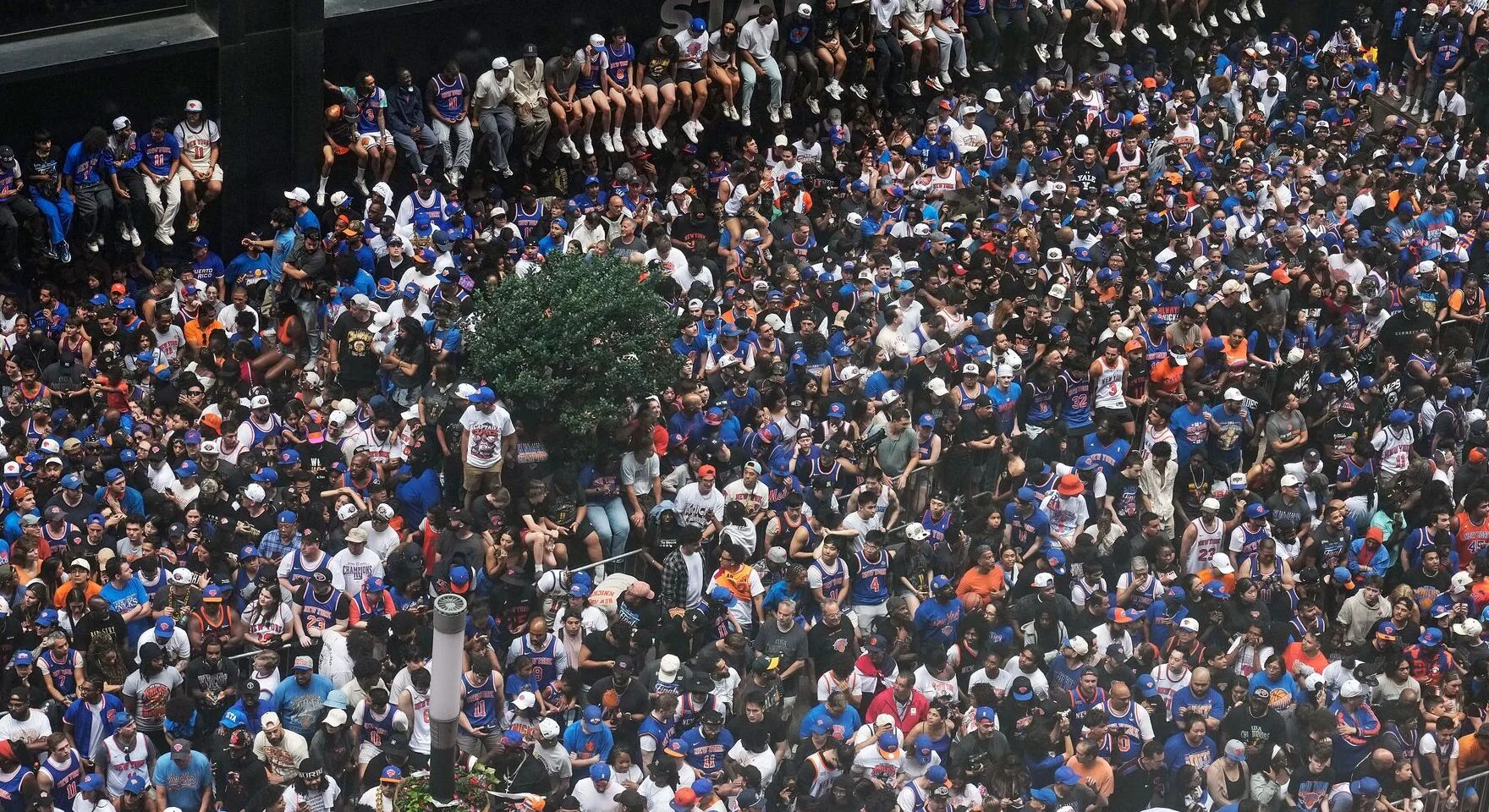
The Knicks parade drew the largest championship crowd in city history. Fans poured into Lower Manhattan before sunrise. Yet the worst chokepoints weren’t on the streets — they were underground. At Fulton, Bowling Green, and City Hall, throngs were stuck for 30 minutes or more because street‑level crowds had nowhere to go.
Above ground, the one‑mile Canyon of Heroes — the shortest championship route in the nation — became a crush of humanity. Many fans never got close enough to see the team. Others were pushed blocks away for safety.
This wasn’t about tradition. It was about capacity.
Meanwhile, other cities give their fans room to celebrate. As parade distances compiled by @JonFromMaspeth show:
- Philadelphia — 4.5 miles
- Chicago — 7 miles
- Tampa Bay — 3 miles
- Los Angeles — 2 miles
- Miami — 2 miles
- Seattle — 2 miles
- Kansas City — 2 miles
- Boston — 2 miles
New York? Again, one very skinny mile.
The largest, densest, most transit‑dependent city in America gives itself the least space to celebrate. That’s not civic pride; that’s poor planning.
And it’s exactly the kind of legacy system Mamdani says he wants to modernize.
Four Options for the Mayor to Consider:
I. Northward Extension (2–3 miles)
Extend the parade to Canal, Houston, or 14th Street.
Pros: More space, better transit distribution, economic benefits for neighborhoods north of FiDi.
Cons: City Hall loses its traditional finale.
II. 14th‑Street‑to–City Hall Southbound Route (2.3 miles)
If City Hall must remain the endpoint, flip the route: start at 14th Street and march south.
Pros: Retains City Hall finale, uses wider Midtown/Union Square corridors, leverages major transit hubs.
Cons: Midtown traffic disruption, extended Broadway closures.
III. West Side Highway Start (2–2.5 miles)
Begin on the West Side Highway, then turn east toward City Hall.
Pros: Vast viewing areas, strong transit access, reduced pressure on narrow FiDi streets.
Cons: Traffic rerouting, fewer small businesses benefit.
IV. Midtown‑to‑MSG Knicks Route (1.5–2 miles)
A Knicks‑specific route ending at Madison Square Garden — using a modified Thanksgiving Day Parade corridor.
Pros: Widest streets in the city, strongest transit access, major Midtown economic boost.
Cons: Midtown gridlock, heightened MSG security demands.
Of course, all of these options raise another question: Why not move most championship parades to weekends?
A weekend parade would reduce weekday business disruption, ease subway strain, and allow more families to attend. It would also avoid the dangerous overlap between commuters and parade‑goers.
The trade‑off: higher overtime costs for police, sanitation, transit, and emergency services. But the city already budgets for major weekend events — the Marathon, Pride, and the Puerto Rican Day Parade among them. A championship parade is no less foreseeable.
A Mayor‑Level Opportunity
Mayor Mamdani created the efficiency‑focused Charter Revision Commission to modernize how the city works. Parade planning may seem small compared to procurement or land‑use reform, but it is a textbook example of how legacy systems — left unexamined — create unnecessary strain on public safety, transit operations, and city workers.
The Knicks parade didn’t expose a ceremonial inconvenience; it exposed a structural flaw. New York is using a mid‑20th‑century parade footprint for a 21st‑century population. The result was predictable and preventable.
If Mamdani wants to demonstrate operational competence, modernize outdated systems, and show New Yorkers what “efficiency” looks like in real life, this is the perfect proving ground.
Updating parade routes isn’t about sentiment. It’s about safety, mobility, economic impact, and basic city management.
The Knicks may contend again. New York cannot afford another day when fans are stuck underground, streets are overwhelmed, and the city’s own systems fail under the weight of success.
A city that plans effectively is a city that functions — and a city of champions should celebrate like one.