


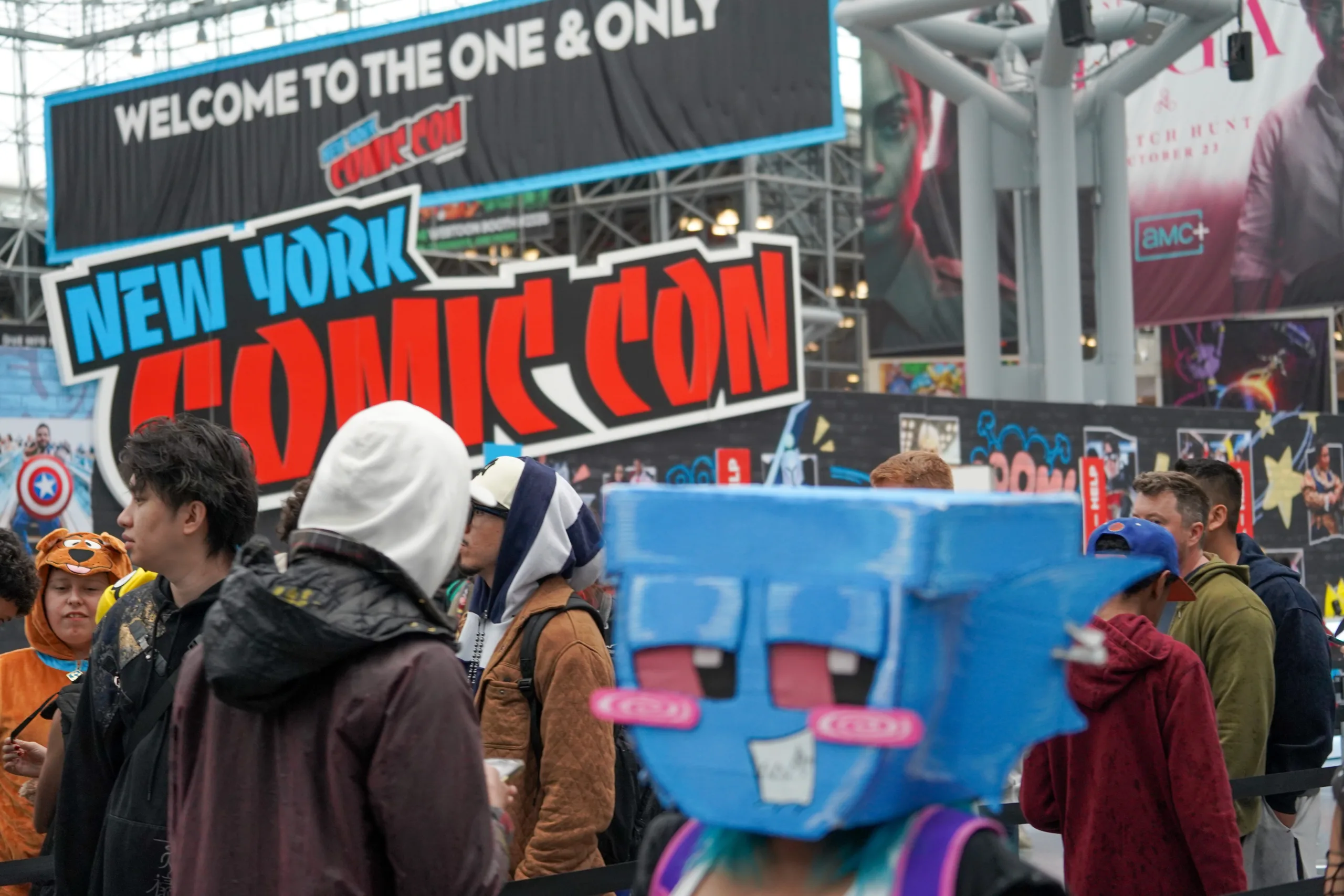
New York has no shortage of characters. But once a year, the city gathers a few hundred thousand of them in one place—along with their favorite superheroes, supervillains, aliens, time travelers, wizards and assorted creatures who would make a zoning board meeting look downright ordinary.
New York Comic Con (NYCC)returned to the Javits Center last weekend to celebrate its 20th anniversary. What began in 2006 as a gathering of comic-book enthusiasts has grown into one of the country’s largest pop-culture conventions, attracting roughly 250,000 attendees in recent years and generating tens of millions of dollars in economic activity.
By attendance, NYCC has eclipsed San Diego Comic-Con, the granddaddy of the genre, which began in 1970. New York’s rapid rise is a particularly New York achievement: arriving late, moving fast and eventually taking the biggest stage.
That transformation offers a useful lesson for New York’s elected leaders. The city can still reinvent itself, attract new audiences and generate economic activity even as traditional industries struggle or move elsewhere.
Getting there, however, takes more than a few radioactive spiders, a billionaire in a bat suit or a generous dose of Hollywood magic. NYCC’s rise reflects the expanding universe of popular culture, the ingenuity of its organizers, public investment in infrastructure and New York’s enduring ability to persuade the world that whatever happens next, it probably ought to happen here.
From Ground Zero to superhero central
When NYCC debuted in 2006, New York was less than five years removed from the September 11 attacks. The city was still rebuilding its confidence, economy and international standing.
The 2004 Republican National Convention had demonstrated that New York could accommodate an enormous influx of visitors under extraordinary security demands. Two years later, Comic Con posed a different challenge: Could the city turn its appeal to a specialized audience into a major event with lasting economic benefits?
The answer was yes—and the crowds kept coming.
The explosion of superhero movies, streaming television, video games, anime and other entertainment enlarged the convention’s potential audience. But cultural enthusiasm alone cannot explain how an event that drew roughly 30,000 people in its first year grew into a gathering of a quarter-million and surpassed San Diego Comic-Con. That takes organization, venue capacity, transportation, hotels, restaurants and a city willing to make room for the hordes.
It also helps when City Hall understands that land use is about more than deciding where a building goes and how tall it can be.
Michael Bloomberg’s administration made economic revitalization a central part of its post-9/11 agenda. Changes to land-use policy and investments in infrastructure were intended to create room for new activity. The extension of the No. 7 subway line to Hudson Yards, a city-state partnership, was one of the most conspicuous examples.
Amanda Burden, Bloomberg’s planning commissioner, recalled the administration’s approach: “[Mike’s] lead was our lead; he saw land use as one of the best tools to do that.”
No one was drawing up a master plan for a quarter-million people dressed as comic-book characters. But the broader philosophy mattered: New York could not simply wait for the economy to bounce back. It had to create conditions in which new enterprises and attractions could flourish.
The Javits Center, expanded and modernized over time, became an essential part of that infrastructure. The expansion gave Comic Con room to grow while making the convention center more attractive to major events that have little to do with capes and comic books.
Autos, boats and other large-scale exhibitions now have the space and facilities to make Javits a regular stop. Fanatics Fest, another pop-culture and celebrity-friendly spectacle, has joined the center’s roster. The result is a more versatile convention economy: one event may bring superheroes, another boats, another cars and another athletes and celebrities. The costumes change, but the economic logic remains consistent.
The transit network and surrounding hospitality businesses complete the picture, helping turn a convention into an economic engine.
Tom Brennan, a comic-book industry veteran who has attended roughly 14 or 15 New York Comic Cons, including nine as an editor, sees the connection between the city’s post-9/11 recovery and the convention’s rise.
“So much of that post-9/11 Bloomberg era was about getting everyone back and opening the doors to everybody,” Brennan said. “New York has always been a host for the future of any industry—a magnet that attracts people.”
The point is not that Bloomberg-era planning alone created Comic Con. It is that public investment and private initiative can reinforce one another. A subway extension and a modern convention center may not sound like the ingredients for a pop-culture phenomenon. But even superheroes need a way to get to work.
The Javits expansion also illustrates why convention infrastructure should be viewed as more than a single-purpose public amenity. A larger, more flexible facility can host overlapping worlds of commerce and culture, giving the city a diversified calendar and the convention center a fuller life.
The business of being New York
The economic benefits extend well beyond the Javits Center. Visitors book hotel rooms, eat at restaurants, ride the subway, buy merchandise and explore the city. Exhibitors and entertainment companies gain access to a concentrated audience, while local businesses get a burst of customers.
Still, the convention sells something that cannot be downloaded: the experience of finding your people.
Jody Fisher, a public-relations professional who has attended for more than a decade with his son Sam, sees NYCC as a miniature version of the city itself.
“New York is every shape, every color, every size, every thought, every creative impulse that we have as humans,” Fisher said. “And New York in Comic Con is what New York is.”
People come to meet creators, see actors, discover new work and celebrate characters who have become part of their lives. In a world where almost anything can be streamed, purchased or discussed online, there remains a market for being in the same room with people who share your enthusiasms.
And the city itself is a character at NYCC. This year‘s event prominently featured Coney Island-related activities (yes, including literal freaks). The NYC Department of Education had both a panel on the immortal artist Jack Kirby and, in the convention’s dedicated family area, a large table (and a classic spinner rack) offering free copies of biographical and historical comics — part of the department’s Civics For All Comics Group initiative.
Brennan has watched popular culture move from the margins to the mainstream. Times Square, he observed, has long been an advertising spectacle, but now its giant billboards and subway promotions feature characters that once belonged to a more specialized corner of entertainment.
“Society has become much more nerd-friendly,” he said,
Copy that, says Kristina Rogers, executive vice president of convention organizer ReedPop: “Twenty years ago…we were a little more shy about being geeky. Now we’re being covered everywhere. Variety is writing about us.”
Call it the revenge of the geeks. The convention now sits at the crossroads of film, television, gaming, animation, fashion and publishing. Studios want the fans’ attention; creators want their audiences; and audiences want to see what comes next. New York provides a ready-made stage for all three.
San Diego may have had the origin story, but New York delivered the sequel with the bigger box office. NYCC’s rise reflects the city’s ability to turn a specialized interest into a mass cultural event—and to do so at a scale that matches its reputation as the capital of everything.
FA family affair, with claws
For all its monsters, weapons and supernatural mayhem, NYCC has become remarkably family-friendly. Children arrive with parents, teenagers meet friends, couples coordinate costumes and new parents dress their babies as carefully as they dress themselves. There may be the occasional outfit that prompts a parent to redirect a youngster’s gaze, but this is hardly the Mos Eisley cantina.
The convention has also become multigenerational. Sam Fisher, now 17, first attended with his father when he was six. This year, the pair arrived as Gambit and Wolverine, continuing a tradition that has become part of their relationship.
For Jody, the experience reaches back to his own childhood, when seeing Star Wars in a movie theater helped ignite a lifelong interest in science fiction, comic books and gaming. Comic Con gave him the chance to pass that enthusiasm along.
For Sam, it has become a place where he can express interests that might otherwise make him feel like an outsider.
“Going to Comic Con every single year is one thing that I love looking forward to,” Sam said. “And every Halloween, you come around, and I always feel like I’m the odd one out doing a lot, and this is my place to really let that part of me shine.”
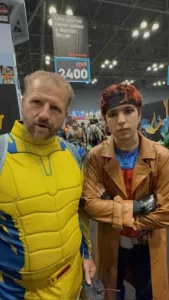
Sam plays jazz guitar and sees the convention as a crossroads where young artists, musicians and fans find common ground. His father’s childhood obsessions have become a shared family ritual, updated for a generation raised on anime, digital art and an expanding pop-culture universe (Sam credits his jazz interests to his parents’ tastes — Steely Dan and the Grateful Dead, yes; Pitbull, no. What generation gap?)
That is a powerful formula for an annual event: Give people a reason to return, and eventually they bring the next generation with them. Even Wolverine, it seems, has a soft spot for family bonding.
Timing is everything—even in another universe
Organizers made another smart move when they shifted NYCC from its early spring dates to October in 2010. The change gave the convention a distinctive place on the calendar: a fall finale to the convention season, coinciding with television premieres and the run-up to Halloween.
Kristina Rogers described the timing as a major advantage. “I think it was a real boon for us, you know, the whole year out. There’s a wrap up and I think that works perfect for us.”
The move helped establish NYCC as a fixture on New York’s fall calendar. It gives fans another reason to visit, entertainment companies a reason to concentrate their attention here and the city another major event to add to its tourism portfolio.
It also helped NYCC distinguish itself from its better known predecessor rather than simply imitate it. San Diego had the history, Hollywood premieres and first-mover advantage. New York had the fall calendar, the Javits Center, the subway and Manhattan’s cultural density. The older convention wrote the origin story; the newer one found a way to win the ratings.
Of course, that success comes with a cost.
Tom Brennan wryly noted, “It used to be you could just walk up and get a ticket. Now it is very expensive and very challenging to get a pass, which is also reflective of post-Bloomberg New York: it has never been a better place to live, but it could not be pricier or harder to live here.”
The challenge for elected leaders is to make sure the people who produce that culture can afford to live and work here. A city cannot run forever on the residual glow of yesterday’s hits, no matter how many reboots Hollywood orders.
Not all heroes wear capes
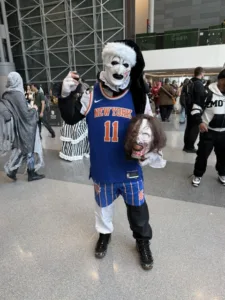
One other costume trend was especially appropriate to New York in 2026: the Knicks.
Alongside the familiar emerald Green Lantern, orange and blue appeared everywhere. Fans sported Jalen Brunson shirts and team caps, while others concocted mashups featuring Knicks/zombies, Knicks/Dr. Doom and, Knicks/Whatever.
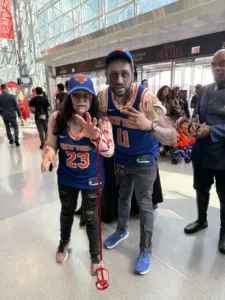
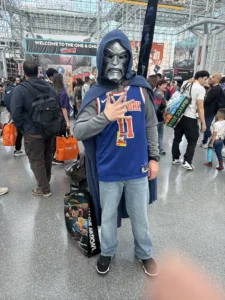
(Photos by Robert A. George)
It was a reminder that New York’s cultural worlds rarely stay in their assigned lanes. Sports, entertainment, fashion and commerce overlap constantly—and that ability to bring people together is itself an economic asset. Besides, in a city that has waited long enough for basketball glory, why shouldn’t a Knicks fan get to be a superhero for a weekend?
Fanatics represents that crossover in institutional form: sports, celebrity, merchandise and spectacle converging under one roof. Its presence alongside Comic Con and other major events shows how the modern convention business has expanded beyond traditional trade shows. Today’s audiences want access, identity and entertainment as much as products. The line between convention, festival and fan experience has become pleasantly blurry.
Twenty years after its debut, NYCC demonstrates what can happen when cultural demand meets organizational vision and infrastructure. Its success does not prove that every public investment will pay off or that every industry can be persuaded to stay. It does show why planning for growth, welcoming new audiences and making room for unexpected enterprises matter.
New York’s post-9/11 resurgence was never going to depend on a single mayor, subway line or convention. It required sustained public and private investment, reliable infrastructure and a willingness to treat culture as an economic and civic asset rather than a decorative afterthought.
The city’s cultural economy will not remain strong by nostalgia alone, nor will it thrive if the workers and institutions that sustain it are priced out. New York must continue to invest in transportation, public space, convention and performance venues, housing and the conditions that allow creative businesses to take root.
It must also recognize the value of facilities that can serve many audiences. The Javits expansion made NYCC more comfortable and ambitious, but its significance reaches beyond one annual gathering. By making the center more attractive to autos, boats, Fanatics Fest and other large-scale conventions, the expansion helped New York build a broader platform for commerce, culture and celebrity.
NYCC succeeded because those elements converged: a global city, a growing audience, capable organizers and infrastructure that could support both. Its eclipse of San Diego Comic-Con shows what New York can accomplish when it combines cultural ambition with practical planning.
Its future—and the future of New York’s broader cultural economy—will depend on whether city leaders continue to make that convergence possible. The city’s greatest superpower remains its capacity to reinvent itself, arrive late to the party and still end up headlining the show.