



Risk is often treated as something to be minimized, whether in personal finance, public policy or everyday life. But economist and author Allison Schrager argues that a society that tries to eliminate risk altogether may also eliminate opportunity. In her new book Worth the Risk, she distinguishes between reckless behavior and calculated risk-taking: the former offers little prospect of reward, while the latter can generate growth, mobility and innovation.
In this conversation, Schrager examines how that distinction applies to New York City’s housing challenges, public pensions, small businesses and the broader role of government. Speaking with Searchlight Editor Robert George, Schrager also considers how excessive risk aversion can deepen inequality—and why the American promise has historically depended less on guarantees than on the freedom to take a chance and realize one’s potential. The conversation has been edited for clarity.
Robert George/Searchlight:
You’ve written extensively about risk, both in personal finance and public policy. You lead off Worth the Risk with the idea that without risk, there is no reward. How do you distinguish between productive risk-taking and simply risky behavior?
Allison Schrager: Finance provides a useful way to think about it. Consider the difference between betting on the Super Bowl as a financial strategy and investing in an S&P 500 index fund. Both involve risk, but one is much more likely to pay off and is better managed than the other. The first is essentially pure risk; the odds are that it won’t work out for you.
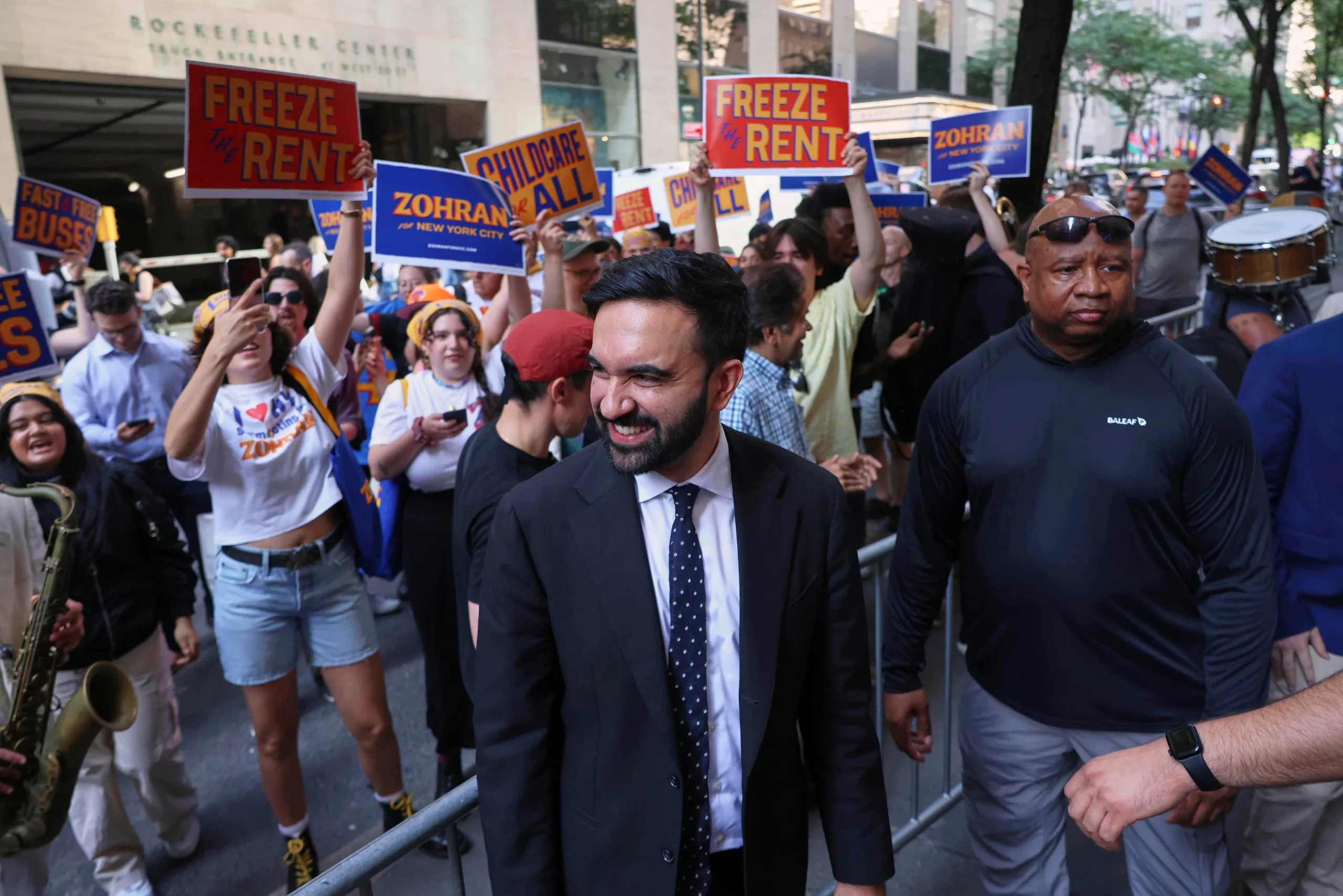
Searchlight: You’ve written about Mayor Mamdani and some of the risks he’s taking in areas such as housing and the city budget. What distinguishes a legitimate government risk from risky behavior by an elected official?
Schrager: There has to be upside beyond the politician’s own political position. There has to be a benefit to the public at large.
I’m not sure Mamdani’s policies offer New York City meaningful upside in that sense. Take the rent freeze. What is the upside. Or take underfunding the pension: If he were taking that money and making investments in the New York economy that could help it grow, one could argue that there’s some upside. But that’s not what he’s doing. He’s spending it.
Searchlight: If you were advising Mamdani on pensions and related fiscal policy, what questions would you want him to ask?
Schrager: Public pensions are tricky because the government is making a risk-free promise to other people. It’s expensive to promise someone no risk because you’re guaranteeing their benefits. You’re not really in a position to take a lot of risk when you’re making that kind of promise because you’re left holding the bag if the risk doesn’t work out. If Mamdani wants to increase revenue to help pay for pensions, I’d encourage him to foster a New York economy where risk-taking pays off—not just for wealthy people, but across the income spectrum.
We want people who work on Wall Street to want to live here and not feel that if they have a huge capital gain, they need to leave the city. Those people are major contributors to tax revenue. But we should also be empowering New Yorkers at all income levels to take more risks.
Think about small-business owners. It’s often not cost-effective for them to take on risk because of all the regulations they face. And I don’t think Mamdani fully recognizes that the solution to the housing crisis is more housing—and building housing is inherently risky.
Searchlight: What do you mean by that?
Schrager: Any developer takes on substantial financial risk when developing property in New York. Yet the city’s philosophy often seems to be capitalism for developers, socialism for landlords—or vice versa. That doesn’t leave enough room for the upside when a building is finally completed.
Someone has to make money on a development for it to be worth taking the risk in the first place. If you want a growing economy that can help pay for pension benefits, you have to empower people across the income spectrum to realize the benefits of taking risks.
Searchlight: Mamdani has talked about reducing regulations on small businesses. From what you’ve seen, is that moving in the right direction?
Schrager: It’s more rhetoric than reality. There are some good things, but a lot of the bigger issues aren’t being addressed.
For example, businesses below 96th Street face an additional premium on their rent. I haven’t seen the administration talk about getting rid of that. There are also licensing requirements and other costs that make it harder to operate a small business.
If you’re serious about encouraging entrepreneurship, you have to reduce those barriers.
Searchlight: Let’s go back to housing. Given Mamdani’s ideological leanings, what could he realistically do to address the housing crisis?
Schrager: The whole appeal of socialism is the idea that you don’t have to face risk—that the state will take care of everything, that your rent won’t go up unpredictably, and that you’ll have safety and security.
Those are attractive ideas, but you don’t get economic growth by trying to remove risk from the economy. It’s like investing in a Treasury bond: you get predictability, but you don’t get much upside.
The only way to really fix the housing crisis is to build more housing. And building housing involves risk. You have to allow the people who build housing to realize the upside. Even the idea that developers are operating under pure capitalism isn’t really true. A substantial portion of new developments have affordable-housing requirements, so the potential profit is constrained from the outset. Add high interest rates and other costs, and the economics become extremely difficult.
Searchlight: You make a broader argument in Worth the Risk that excessive risk aversion can actually worsen inequality and unaffordability. How does that work?
Schrager: People often hear the argument that we should take more risks and think, “Only rich people can afford to do that.” But it’s actually the opposite.
Rich people are taking risks because we’ve constructed an economy in which it’s very expensive for everyone else to take risks. Someone like Elon Musk can afford to take a risk because he has resources. But for most people, changing jobs, moving or starting a business can be extremely costly.
We’ve also constructed compensation systems in which a large part of people’s compensation comes through benefits rather than salary. So changing jobs can mean giving up health insurance or other benefits.
Yet changing jobs is one of the ways people’s incomes generally increase. That’s part of why wages have stagnated or grown slowly at the lower end of the income distribution while continuing to grow much faster at the upper end.
Searchlight: So the regulatory environment effectively puts a tax on people with fewer resources—one that people with greater resources can more easily absorb?
Schrager: Exactly. People with wealth aren’t as dependent on those systems. Elon Musk doesn’t have to worry about getting health insurance through his employer. He can afford to pick up and move if he wants. Most people don’t have that option.
Searchlight: What specific regulatory reforms would you recommend for New York City if the goal is to make productive risk-taking easier?
Schrager: For one thing, make it easier to operate a small business. I’m glad Mamdani has talked about making it easier to have things like food carts, but brick-and-mortar businesses also need deregulation. Commercial landlords and tenants face unnecessary taxes, licensing requirements and other costs.
And the big thing is making it economically viable to build housing. If you do that, people at all income levels benefit.
Mamdani keeps pointing out that middle-class people are leaving the city. They really can’t afford housing anymore.
Searchlight: What else could he do on housing?
Schrager: He could go to Albany and push to relax some of the 2019 rent-stabilization regulations. Those rules have effectively kept tens of thousands of units off the market.
And the rent freeze sends a message to landlords that they shouldn’t invest in apartments, let alone build or improve them.
The broader point is that if you want more housing, you need to make housing investment attractive enough for people to take the risk of building it.
Searchlight: What about the cost of living beyond housing?
Schrager: The government’s approach to grocery prices is another example. If food prices rise, that creates uncertainty for people because they don’t know what their income will buy.
The response has been to have government subsidize food, which can be important for lower-income people. But another approach would be to relax regulations that make it difficult for major retailers to operate in the city.
A company such as Walmart can provide predictable pricing and lower costs. That’s another way of making people’s lives less financially risky.
Searchlight: You’ve suggested that this isn’t just a Mamdani phenomenon. It seems that politicians across the political spectrum increasingly emphasize safety and security rather than encouraging smart risk-taking. Is that a broader cultural shift?
Schrager: Yes. I think we’re part of a long-running evolution in which the government’s role has increasingly become protecting people rather than enabling them to reach their potential.
If you look at earlier versions of America, the government was often trying to enable people to take risks. The Homestead Act is a good example. It was a risky proposition, but the government rewarded you if it worked out.
We used to understand that the American dream wasn’t: “If you work hard, you are guaranteed to get X.” That suggests a guarantee. It was that you could come here, take risks and realize your potential.
There were never guarantees. And the lesson we know from finance is that there are no guarantees without giving up some upside.
Searchlight: One of the arguments in Worth the Risk is that excessive risk aversion can actually increase inequality and unaffordability. Why?
Schrager: Because risk-taking isn’t something that only rich people do. We’ve made risk-taking expensive for ordinary people. If you’re wealthy, you can absorb failure. If you’re not, the cost of moving, changing jobs or starting a business can be enormous. So the people with the fewest resources are often the ones least able to take the risks that could improve their circumstances.
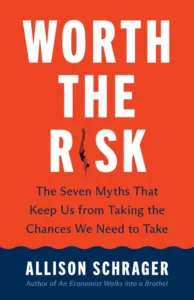
Searchlight: Let’s turn to the book itself. What are two or three things you most want readers to take away from Worth the Risk?
Schrager: First, that risk-taking is something we should embrace. It’s something you should foster in your children. Second, people often think, “I’m either a risk-taker or I’m not,” or “That’s too risky for me.” But we’re all risk-takers in different ways.
Most people have some domain in which they’re actually very competent at taking risks. They’re comfortable making decisions and assessing uncertainty in that area, and they may take much bigger risks than other people would.
The trick is to recognize that you already have that capacity and learn how to apply that way of thinking to other areas of your life.
Searchlight: And that’s perhaps a good place to leave it. Thanks very much, Allison.