



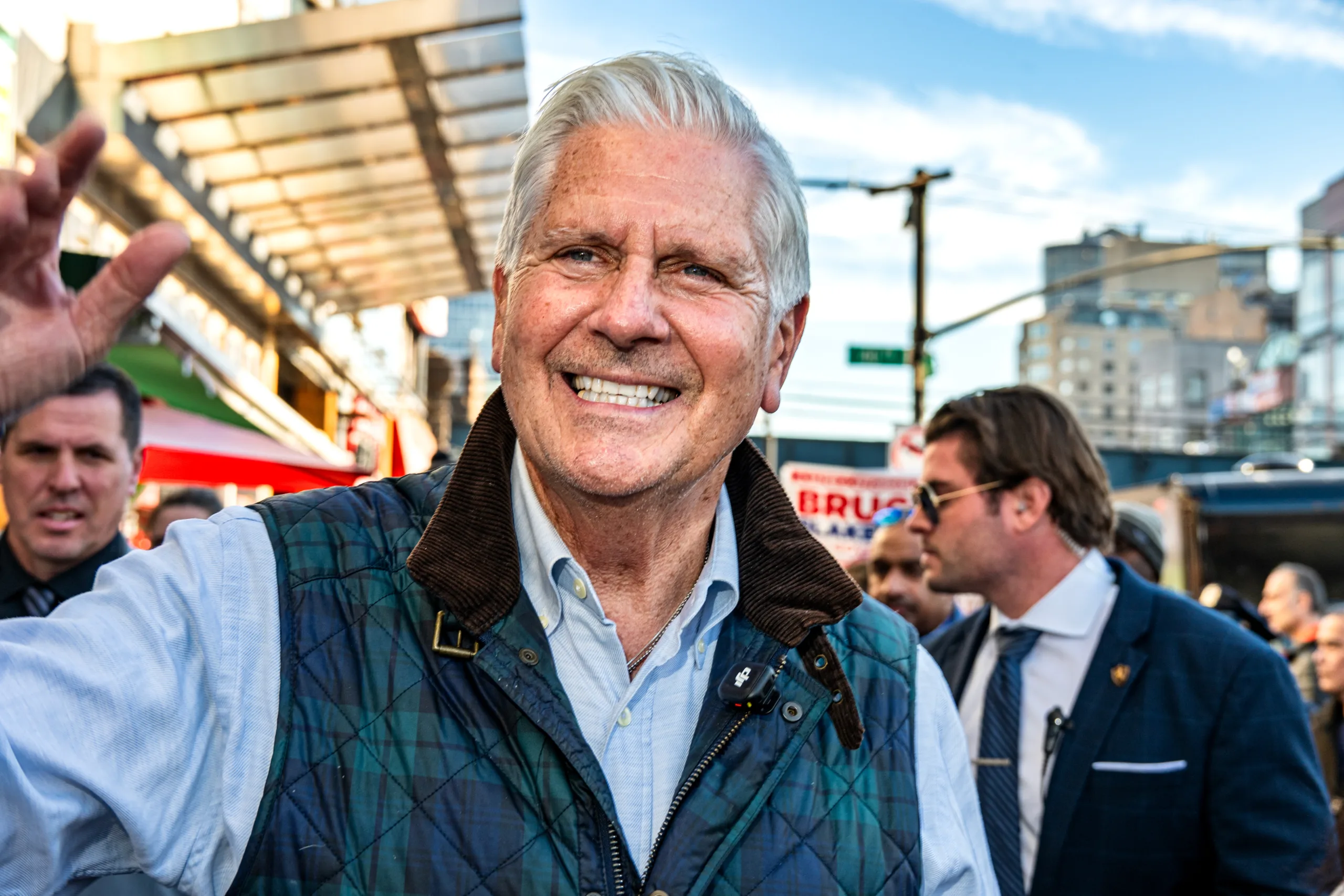
What would it take to make New York affordable again—and which candidate for governor has a credible plan to do it?
I was asked to address this question. The answer begins with a basic proposition: New York needs a governor willing to confront runaway spending, high taxes and the persistent loss of residents. Republican Bruce Blakeman offers an alternative to incumbent Democratic Gov. Kathy Hochul, whose administration has continued a pattern of budget growth that New Yorkers can no longer afford.
In January 1975, newly elected Democratic Gov. Hugh Carey delivered a grim assessment of New York’s condition in his State of the State address. “The days of wine and roses are over,” he declared, confronting a state in desperate financial straits after more than a decade of lavish tax and spending increases under Gov. Nelson Rockefeller. Albany had behaved as though New Yorkers could remain indifferent to ever-rising taxes indefinitely.
At the time, the state budget stood at slightly more than $10 billion. Fast-forward to 2026, and Albany spends approximately $268 billion. Inflation has dramatically changed the value of a dollar, but even after accounting for it, the growth in government spending is enormous.
Do you—or any New Yorker you know—feel that state government is five times as effective, efficient or otherwise better than the government your parents or grandparents experienced?
Since 2019, the last full year before the pandemic, state spending has climbed from roughly $175 billion to $268 billion. New York needs essential public services, but spending more money is not the same as solving problems. When government continually demands more revenue without demonstrating comparable improvements, taxpayers have every right to ask what they are getting for their money.
Blakeman has made fiscal restraint central to his campaign. His proposal to eliminate state income taxes on the first $50,000 earned by single filers and $100,000 earned by joint filers would offer meaningful relief to eligible households. The plan’s costs and financing deserve scrutiny, but the objective—allowing working New Yorkers to keep more of what they earn—is sound.
The governor has substantial tools to pursue reform, including the authority to propose an executive budget, exercise a line-item veto and make significant appointments. Those powers can challenge entrenched spending patterns, scrutinize state contracts and demand accountability from the agencies and outside organizations that carry out government programs.
The question is whether the next governor will use those tools to change Albany’s habits or simply manage the existing system.
Consider the most basic measure of New York’s economic health: whether people want to live here.
In 1975, New York had 39 representatives in Congress. Today it has 26. That decline is not the result of partisan gerrymandering. It reflects population trends and the state’s failure to keep pace with national growth. Slow growth has many causes, including global competition and industrial restructuring, but high taxes, regulatory burdens and the cost of doing business have also made it harder to attract and retain employers.
Once-dominant upstate companies such as Eastman Kodak, Xerox, Carrier and Corning Glass illustrate the economic transformation that has reshaped communities across the state. Why assume the same policies will suddenly produce a different result?
Albany should be particularly concerned about New Yorkers moving to Florida. Residents leave for many reasons, but lower taxes and a more affordable business environment are important considerations. When they move, New York loses more than tax revenue. It can lose entrepreneurs, skilled workers, investors and the economic activity that sustains communities.
The political consequences could be significant. The 2030 census will determine congressional apportionment for the following decade. If New York continues to lag in population growth while Florida gains residents, New York could lose additional House seats as Florida gains them. The precise outcome depends on nationwide trends, but the stakes are clear: population shifts can mean less revenue and less political influence.
The fiscal comparison is equally striking. New York’s state budget is approximately $268 billion, compared with Florida’s roughly $118 billion. Florida has a larger population, yet its state budget is less than half New York’s. Differences in state responsibilities and accounting make the figures imperfect comparisons, but the disparity raises an obvious question: Why does New York spend so much more, and what additional value do taxpayers receive?
Florida Gov. Ron DeSantis has emphasized spending restraint and pursued budget reductions. Florida has its own problems, but it demonstrates that a larger population does not automatically require a state budget on New York’s scale.
Hochul has presided over substantial spending growth. Her administration can point to investments in public services, but that does not settle whether those investments justify the tax burden. New Yorkers deserve a clearer explanation of how Albany intends to restrain spending, improve efficiency and compete with lower-tax states.
Blakeman’s proposals won’t solve every problem overnight. But reining in spending and easing the income-tax burden on lower- and middle-income New Yorkers would be a meaningful start. The challenge is to make those changes sustainable while preserving essential public services.
For voters concerned about affordability, none of this is an abstract accounting exercise. Taxes and government fees affect the cost of running a business, buying a home, hiring employees and raising a family. They influence whether a young worker stays in New York, an entrepreneur opens a business here or elsewhere, and a retiree decides another state offers a better deal.
New York cannot sustain prosperity if the cumulative cost of living and doing business encourages residents and employers to leave. A shrinking or slower-growing tax base can make public services harder to finance, creating pressure for still higher taxes on those who remain. That is a cycle Albany needs to break.
Hochul must explain why the current approach should deliver better results. Blakeman must demonstrate that his proposed tax cuts and spending reductions can be implemented without creating new fiscal problems or compromising essential services. Campaign promises must ultimately be judged by their costs, feasibility and results.
New York has faced fiscal reckoning before. Hugh Carey’s warning in 1975 followed years of expansive spending and a growing recognition that the state could not continue on its existing path. Half a century later, the lesson remains relevant: taxpayers are not an inexhaustible resource.
Albany’s challenge is to make government affordable, restore economic competitiveness and give residents reasons to stay. That requires disciplined budgeting, a more competitive tax environment and greater accountability for public spending.
The question is not whether government has a role. It is whether government can deliver what residents need without continually making life more expensive for the people who pay for it.