



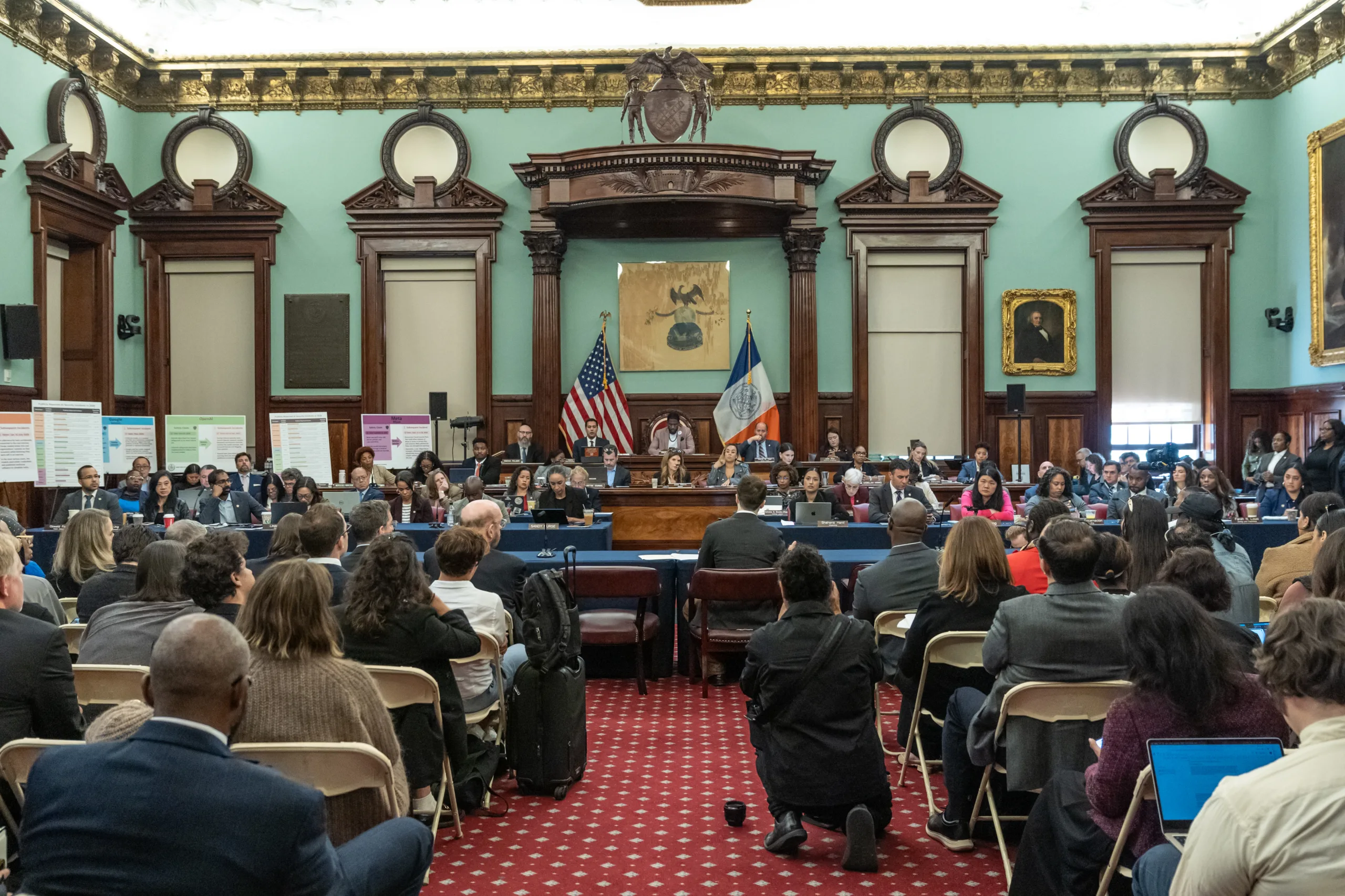
On Monday, the New York City Council held a nearly 12-hour hearing on artificial intelligence, taking testimony on a sweeping package of proposals that touched everything from frontier AI model safety and third-party validation requirements to transparency rules, cybersecurity, employment impacts, and the use of AI across city government.
The breadth of the hearing underscored the promise of AI, the challenge of regulating it, and how this technology is far too complex and impactful to analyze thoroughly in a single hearing. Council Members grappled with important questions: How should government prepare for rapidly advancing AI systems? What protections are needed to address legitimate risks? And what role should New York City play in governing a technology that operates across state, national, and international borders? But at the end of the night, a key issue was left almost wholly unaddressed: how the Council’s proposed legislation would impact startups and AI-powered small businesses.
As the Council considers these proposals, it is critical to ensure that efforts to address legitimate concerns do not unintentionally snuff out New York’s entrepreneurial spirit.
The companies with the most to lose from some of the Council’s proposed AI regulations may not be the giant tech firms most New Yorkers associate with artificial intelligence. They may be the five-person startup in Brooklyn, the small business adding an AI-powered customer service tool, or the founder deciding whether New York is the right place to build her next company.
As drafted, several bills under consideration pose requirements that may be impossible to meet for the frontier AI companies whose technology underpins an increasing number of NYC industries today. But perhaps even more importantly, these rules could hold startups and small businesses responsible for AI models they did not build, cannot inspect, and have no ability to change. Those companies could face significant penalties and liability without even having a clear way to comply.
For New York, that should be a major concern, and it was one of the issues my organization, Tech:NYC, raised at Monday’s hearing.
Our city has spent years building one of the strongest startup ecosystems in the world. The New York metro area now has the largest tech workforce in North America, with nearly 400,000 workers. We have become the country’s second-largest market for AI talent. And increasingly, that talent is spreading throughout New York’s economy — into finance, health care, media, professional services, and businesses that may never describe themselves as technology companies.
The Council shouldn’t unintentionally undermine that progress with rules that are especially difficult for young companies to navigate.
Most AI startups do not build their own foundation models — they use models developed by other companies and build products on top of them. They control their own product design, customer relationships, and data practices, but they generally do not control how the underlying model was tested or validated.
Yet one bill before the Council would prohibit a company from deploying an AI model that has not received third-party validation. The developer of the model is responsible for obtaining that validation, but the startup using the model could still face a penalty of $25,000 per “instance” of deployment if the developer has not done so.
This is the wrong approach. A startup should be accountable for the decisions it makes and the products it builds — not be put in the position of guaranteeing how another company trained a model or certifying technical work it cannot see.
The problem becomes even more difficult when these rules are written city-by-city.
AI models are not designed for one municipality at a time. The same model powering a product in Brooklyn may also power that product in Boston, Chicago and London. If New York City establishes its own validation system, liability standards, and reporting requirements, and other cities adopt different versions, big companies and startups alike will have to figure out how to comply with a growing collection of local regimes.
Large companies have lawyers and compliance departments that can navigate that complexity, but they will still think twice about adding their headcount and taking more office space in a city with a different policy regime than anywhere else. Early-stage companies — which are smaller and can change headquarters with ease — do not have the same resources.
New York State has already begun addressing frontier AI safety through the RAISE Act, which focuses on the largest model developers. Other states are working on these questions, and ultimately many of the biggest issues surrounding frontier models require national — and in some cases international — coordination. That is how we should build rules for technology that operates across borders instantly.
None of this means the City Council should sit on the sidelines.
In fact, Comptroller Mark Levine recently made a compelling case that New York City has an enormous amount of AI-related work to do. City agencies need to prepare for AI-enabled cyber threats, schools need to adapt, and workforce programs need to anticipate changes in jobs. And City Hall itself should figure out how to use AI responsibly to make government easier to navigate. Levine offered the example of allowing New Yorkers to apply for benefits by speaking into their phones in the language they are most comfortable using.
The Council can also set strong standards for the AI tools city agencies purchase and use. It can enforce existing consumer-protection and anti-discrimination laws. And it can make sure workers, students, nonprofits, and small businesses have access to training and understand how these technologies are changing their fields.
Those are enormous responsibilities. They are also areas where city government has both the authority and the ability to make a tangible difference.
The hearing’s aforementioned wide breadth is precisely why New York should resist trying to “solve” AI as one giant policy problem. There is no single AI issue, and there will not be a single legislative answer. The better approach is to identify specific harms and risks, determine who actually has the power to prevent them, and design rules that can work in practice.
New York should absolutely protect people from real harms caused by AI. Clear and workable rules can give consumers confidence and give companies certainty.
But the goal should be to make New York both a leader in responsible AI and the best place in the world to build the companies that will shape what comes next. We should not assume those goals are in conflict — and we should be especially wary of rules that put the greatest burden on the companies with the least power to comply.