




Every year, New York City’s 59 community boards send City Hall lists of each neighborhood’s needs. City agencies respond to those requests. In theory, it’s a straightforward accountability loop: residents identify a problem, the city answers, and the public can see what happens next. In practice, that loop often breaks down.
The problem is partly a matter of paperwork. The requests and responses live in different places: one in a dataset on NYC Open Data, the other in annual PDF reports. A board member trying to find out whether a crosswalk request from last year was funded may have to match the records by hand. It’s tedious work—and a good way for useful information to go undiscovered.
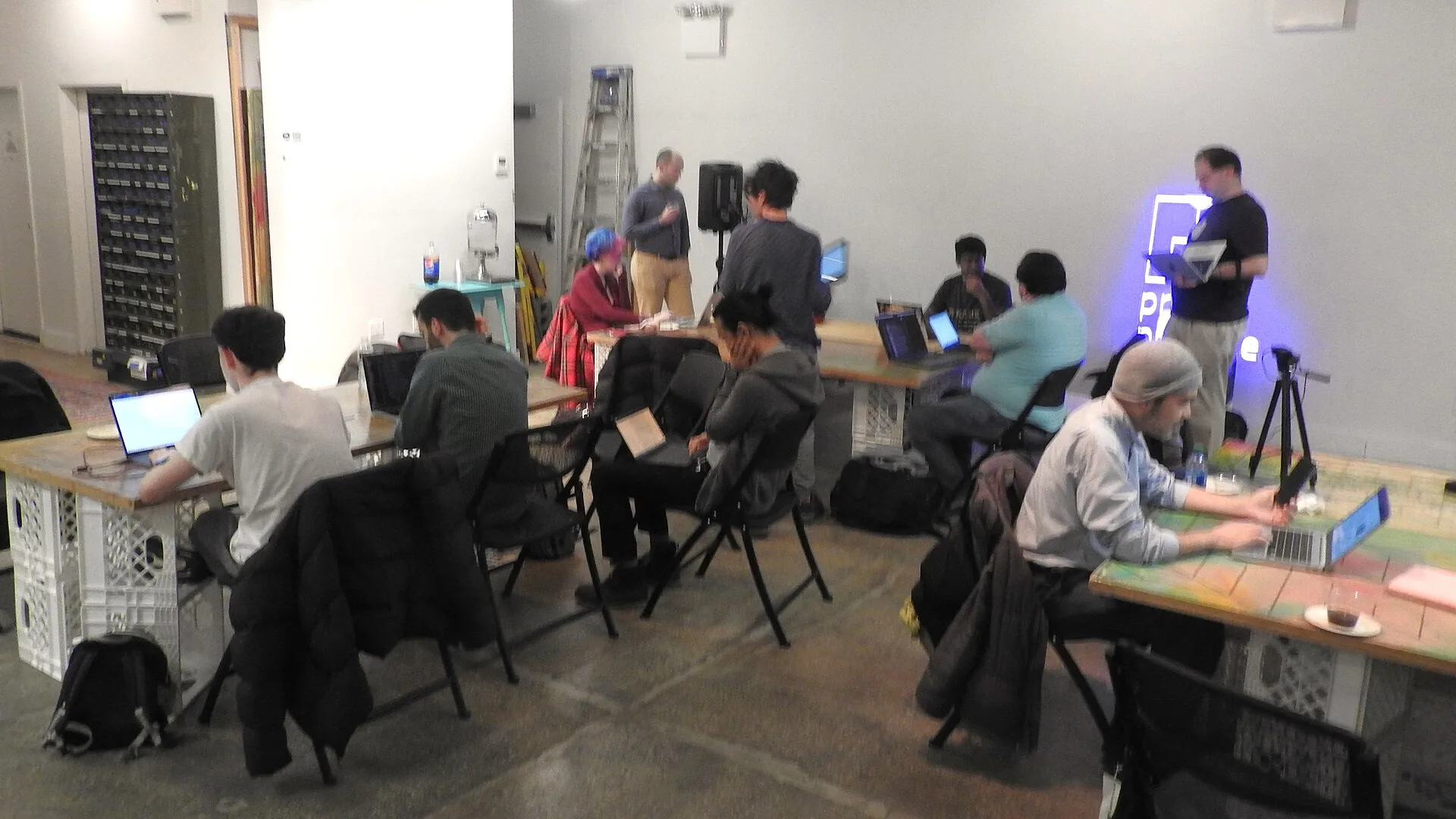
At a September AI hackathon, a team connected those dots in about two hours.
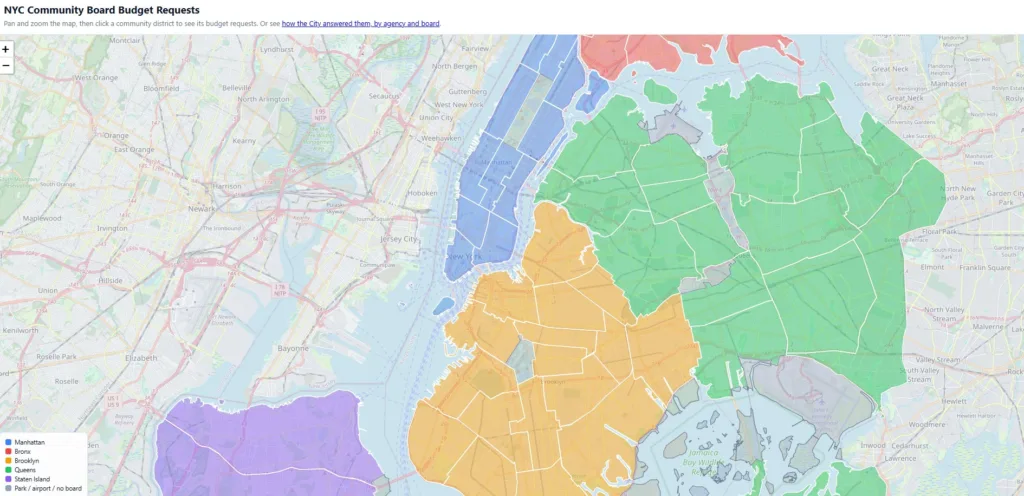
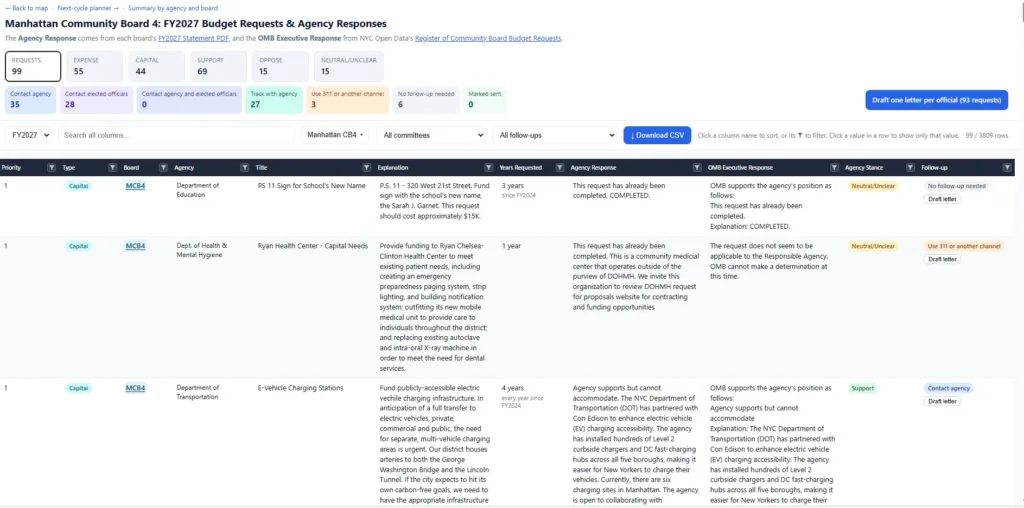
Its tool, Budget Requests, brings together community boards’ requests dating back to 2019 and the city agencies’ responses. Choose a district on the map to see its history. A planning view compares budget requests with local 311 complaints, highlighting issues residents keep reporting that may not appear on the board’s list. The tool can also draft a follow-up email to the responsible agency or elected official. Try it for yourself.
Building technology with the people who use it
How this prototype came together is a story of what inclusive, equitable usage of AI can make possible. For example, it’s easy to see how this tool could be expanded to include resident feedback for their elected officials.
We run the State Capacity Ecosystem, a community of public servants, technologists, and civic groups working to help government deliver better results. We maintain a directory of more than 300 organizations focused on strengthening government, hosting build nights where teams create working tools in a single evening, and keeping the conversation going through Slack and Substack. Partners including Civic Roundtable and CUNY’s Public Interest Technology (PIT) Lab generously provide space.
At these build nights, we bring together people with different kinds of expertise: technologists who can build, public servants who know how government works, data and design specialists, and the people who experience the problem firsthand. You don’t need to know anything about AI to take part. Government experts check in with teams as they work.
Together, participants use their knowledge—and AI—to develop and test practical solutions. AI lets people describe what they need in plain English, see a working version quickly, and refine it on the spot. That keeps the people who will use a tool involved in shaping it. As one public servant put it, “AI meant for the first time we could weigh in on design and product decisions instead of [contractors] beelining towards writing code.”
Community boards as a case study
For community boards, AI offers a chance to fix some basic but persistent problems.
Too often, members must wade through individual PDFs before meetings. New members are expected to learn board procedures largely on their own, including Robert’s Rules of Order. And when term limits begin to push longtime members out in 2027, boards risk losing years of institutional knowledge—with no reliable system for preserving it.
Budget Requests won the hackathon, but other teams took on related challenges. BoardCast turns meeting minutes or transcripts into social media posts and follow-up emails. BoardOS gathers a member’s pre-meeting reading in one place. Robert Rules—developed with a community board member with firsthand experience in procedural disputes—teaches board governance through a more engaging, interactive format.
Until recently, building custom software for community boards was hard to justify: their needs were real, but rarely large enough to warrant an expensive technology contract. The hackathon offers a glimpse of a different model—one in which people can build modest, useful tools without waiting months or years for a procurement process to run its course.
Three suggestions to make NYC a leader in good AI usage
AI done right means government delivering more value in a way that aligns to policy and values. Today, NYC spends billions of dollars on outsourced technology. But building technology no longer requires weeks of user interviews, months of external consultant coding, and a short prayer that the final product matches the original need. AI lets people who experience a public problem help design a solution, prototype it the same evening, and iterate until it works for them. That is democracy in a nutshell.
The first step to unlocking AI’s value is removing broad institutional bottlenecks and blockers to technology procurement and deployment. NYC’s Commission on Government Efficiency’s (COGE) agreed, but none of their technology recommendations made it past the report’s appendix.
New York should build on work already underway at the city’s Office of Technology and Innovation (OTI) and adopt three practical reforms:
- Create a faster path to buy and test new technology. Traditional city procurement can take so long that a tool risks becoming outdated before it is ready to use. It’s like if you were forced to buy an iPhone 6 when iPhone 8 was already out. COGE noted that technology is evolving faster than the city’s usual contracting and budgeting processes. But in fiscal year 2025, competitive sealed proposals took a median of 387 days to complete citywide, and the draft’s cited figure for OTI was 1,372 days. The city should expand challenge-based procurement for smaller software and AI pilots, maintain a list of prequalified vendors for quicker assessments, and buy systems in smaller, compatible pieces rather than locking agencies into one giant contract.
- Give OTI the capacity to help every agency. Many city websites and internal systems are outdated, disconnected or difficult to use. A stronger in-house OTI team could help agencies connect information, reuse tools that already work, and avoid paying repeatedly for similar solutions. Colorado recently made such a change and is now the leading example on how government can successfully implement new technologies. New York’s Public Interest Technology (PIT) Crew is a promising start, with technologists working alongside agencies to build digital services. After such a great first step, the city should find ways to expand hands-on support so agencies have help not just with launching a marquee project, but with all the rest of the day-to-day plumbing too.
- Update civil service rules to recruit and retain tech talent. Modern technology requires skilled engineers, designers, product managers and researchers—not just contracts with outside vendors. COGE reported that the Department of Citywide Administrative Services (DCAS) was exploring changes to IT job titles to help the city attract and retain specialized talent. That work should move forward, including salary ranges that let city government compete for people who might otherwise choose a startup or a large technology company. Better technology starts with people who can build it, understand its users and keep it working.
What’s next
We’re building a movement for better government. We’ll keep connecting people and organizations, hosting build nights, and sharing what we learn so that more public servants and residents can turn practical ideas into working tools.
The next step depends on people beyond our own community. We need builders with a civic-tech problem they want to solve; public servants eager to learn how emerging tools can help them do their jobs; philanthropic and venture funding to support the ecosystem over time; and more attention from everyone who cares about government’s ability to deliver.
If that sounds like you, reach out and join the work.