




When the City Council passes legislation, two things are supposed to happen: the Council tells an agency what to do, and the city supplies the money and people to do it.
In practice, only the first step is reliable. Every year, local laws create dozens of new obligations, ranging from recurring reports to new enforcement duties to process-compliance requirements. Local Law 5 of 2014, for example, requires the Police Department to publish monthly traffic-collision data searchable by intersection. These legislative mandates quietly determine how agencies actually spend their staff time.
To make the full set of obligations visible, the NYC Council Legislation Implementation Tracker distills each law into its concrete requirements: who must act, what they must produce, by when, and how often. The tracker currently covers more than 8,000 obligations drawn from more than 2,000 local laws enacted since 2014. Users can filter by agency, sponsor, obligation type, and recurrence.
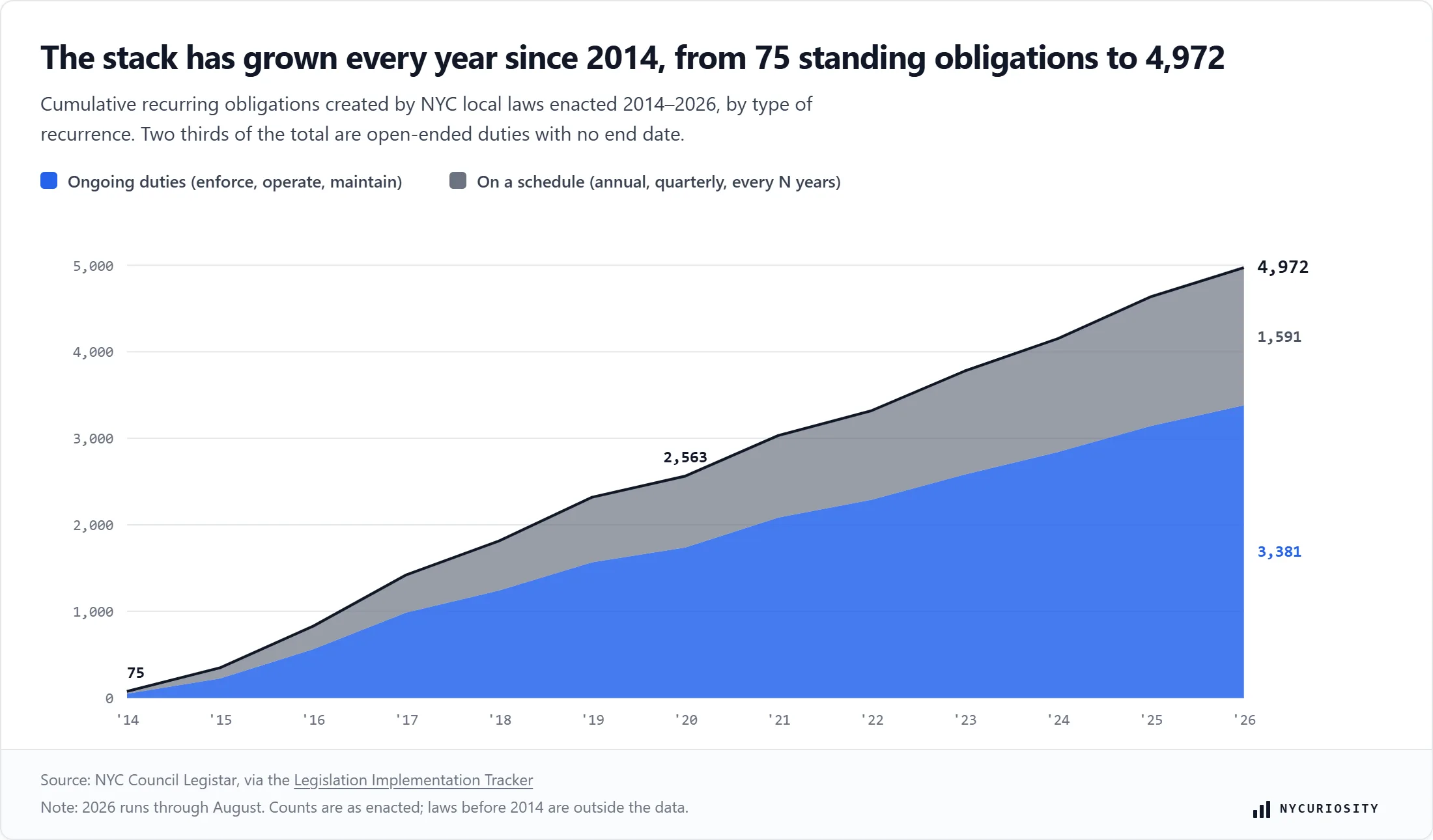
Most of those obligations never disappear. They remain on the books unless a later law repeals them or the original statute contains its own expiration date. Only 155 of the 2,138 laws examined carry such a sunset. Since 2014, the Council has therefore added nearly 5,000 new standing obligations—an accumulating administrative load that consumes thousands of staff hours and millions of dollars every year.
The report explosion
Reporting requirements dominate the ledger. Of the 8,185 obligations catalogued, 1,543 are reports; 850 of them recur at least once a year. That produces an average of 67 new recurring reports every year. Two practical questions follow immediately: Can agency staff keep pace with a constantly lengthening list? And can Council members actually read and act on the resulting volume of paper?
Evidence from the Department of Records’ (DORIS) register is sobering. Of the 728 required reports whose filing status can be verified, 214 have never been filed at all and another 143 are overdue. (Josh Greenman’s NYC Overdue Reports tracker worked out the method for this measurement.) A report that has never been submitted is either unnecessary or unresourced. In either case, the Council should either repeal the requirement or fund the capacity to meet it.
The burden is heavily concentrated. Ten agencies carry six in ten of the Council’s mandates. The Department of Health and Mental Hygiene leads with 582 obligations, followed by the Department of Buildings (564), the Department of Consumer and Worker Protection (482), and the Department of Transportation (442). These are the agencies New Yorkers most often complain are slow. The correlation is not coincidental: the Council has loaded them most heavily. Reducing their obligation count or increasing their staffing would improve service delivery more effectively than most other reforms.
Mandates without money
While every one of these obligations is well-intentioned and individually serves an important purpose, they do not exist in a vacuum. An agency tasked with more obligations will, predictably, move more slowly and require more funding to accomplish its mandates.
And while the City Charter requires a fiscal impact statement (FIS) before the Council votes on a bill, it does not actually require appropriating the money the FIS predicts will be needed. As with the obligations tracker, I have also tracked every fiscal impact statement since 2014, and the 219 local laws with measurable fiscal impacts add up to over $7.5 billion in net costs.
In theory, the Council and the Mayor should factor new mandates into budget negotiations and supply corresponding resources. Political reality intervenes. Rotating Council members and mayoral administrations inherit earlier mandates; the overall budget is already strained. The result is that new duties routinely arrive without new dollars.
Labor costs are especially invisible. Across 254 fiscal impact statements, only 13 percent even mention personnel. Another 18 percent simply declare that the new work will be “absorbed within existing resources” — language that shifts the real cost onto existing staff and existing programs. The arrangement is politically convenient. A Council member can claim credit for safer buildings or greater transparency without having to raise taxes or cut something else. The cost lands instead on the agencies ordered to do more with less, and New Yorkers experience the consequence as slower permitting, delayed inspections, and unanswered correspondence.
Four fixes that preserve oversight
Oversight remains essential; the tracker does not argue for fewer obligations in principle. It argues for making the cumulative cost of those obligations as visible as their individual benefits. The Council can improve both accountability and government effectiveness by adopting four practical changes, none of which reduces its power to legislate or to demand information.
First, put a labor price tag on every mandate. Require every bill that imposes an ongoing duty to state, in plain language, which unit will perform the work, roughly how many staff hours the work will consume per cycle, and whether those hours are incremental or diverted from existing tasks. Even without forcing an appropriation, the public estimate creates a running ledger of why certain agencies slow down and where the heaviest burdens sit. Council members drafting the next bill can then see the existing load before adding to it.
Second, make the funding decision explicit and on the record. When a fiscal impact statement identifies a recurring cost, the bill itself should name a funding source or the Council should take a separate, recorded vote to require absorption within existing resources. Members would remain free to pass unfunded mandates; they would simply have to acknowledge the choice publicly rather than leave it implicit.
Third, sunset new reporting requirements and advisory bodies by default. Attach a five-year or ten-year expiration, renewable by simple majority vote, to any new recurring report or advisory body. The precise timeline can vary by obligation type; the crucial shift is that expiration, not permanence, becomes the default. Requirements that prove valuable can be renewed; those that have outlived their usefulness simply lapse.
Fourth, retire what has already died. The Charter already created the Reports and Advisory Board Review Commission and empowered it to waive obsolete reporting requirements. But the commission has only used that power 28 times, while local laws required or revised over 1,500 reports. Give the commission a more active role: automatically refer to it any report that DORIS shows has gone unfiled for two consecutive cycles, and require a formal retention vote. Dead requirements would finally be cleared from the books instead of continuing to generate phantom workload.
Transparency does not dictate whether the Council should create more obligations or fewer. It only ensures that members can see the full context before they legislate. When the existing ledger of demands is visible, new laws can be written with a clearer understanding of the administrative capacity they will consume. Agencies can then spend less time chasing unfunded paper and more time delivering the services New Yorkers actually notice.