



If you’ve looked at an electric bill recently, you’ve seen it’s a lot higher than it was just a few years ago. New Yorkers need—and need to feel—real relief.
Yet even after passing some of the boldest climate legislation in the country, meant to accelerate clean and efficient energy, our roofs still look like blacktops. Solar adoption has stalled, and renewables now make up a smaller share of our energy mix than they did a decade ago. For many households, the costs and benefits simply haven’t penciled out.
The Inflation Reduction Act made major investments in domestic battery and solar panel manufacturing, boosting availability and local economic impact. It also provided grants for a limited number of low-income households. But by focusing on production, most IRA interventions were too far upstream for consumers to feel the benefits directly.
And without pairing solar deployment with battery storage, the subsidies weakened the power of the sun itself. Solar panels alone can’t provide electricity on cloudy days or at night, nor can they help households take advantage of price fluctuations by storing energy and sending it back to the grid when demand spikes. As cities like New York face more frequent heat waves—forcing us to crank ACs, straining the grid, and triggering neighborhood outages—battery storage would provide backup power and even allow properties to send electricity to others in need.
Ironically, the U.S. now has a surplus of batteries. The rollback of electric vehicle credits has slowed domestic EV production, leaving American battery manufacturers with fewer auto-industry customers and a glut of supply. Many of these batteries are being redirected to utility‑scale storage—important, but still too diffuse for residential consumers to feel the impact.
Another paradox: utilities have a regulated financial incentive to oppose distributed energy resources (DER) like rooftop solar and batteries. Rising electricity demand—from our plugged‑in devices to data centers to extreme weather—strains distribution grids. Operationally, utilities would benefit from more distributed generation: if more customers produced and stored their own solar power, utilities wouldn’t need to push as much electricity through aging substations.
But regulations guarantee utilities a specific rate of return on their own capital investments. That means they profit more from building centralized infrastructure—like expensive substation upgrades—than from supporting customer‑owned solar and battery systems. The CFO’s financial incentive often outweighs the COO’s operational need, with some utilities even arguing against DER deployment.
In New York City, the challenge goes deeper: most batteries aren’t even allowed in residences. While working to manage a rapidly evolving technology, the Fire Department has permitted only one battery type for residential use. Look at a satellite image of the five boroughs and you’ll see only a scattering of solar panels—at a moment when every safe roof could be its own clean, resilient “virtual power plant.”
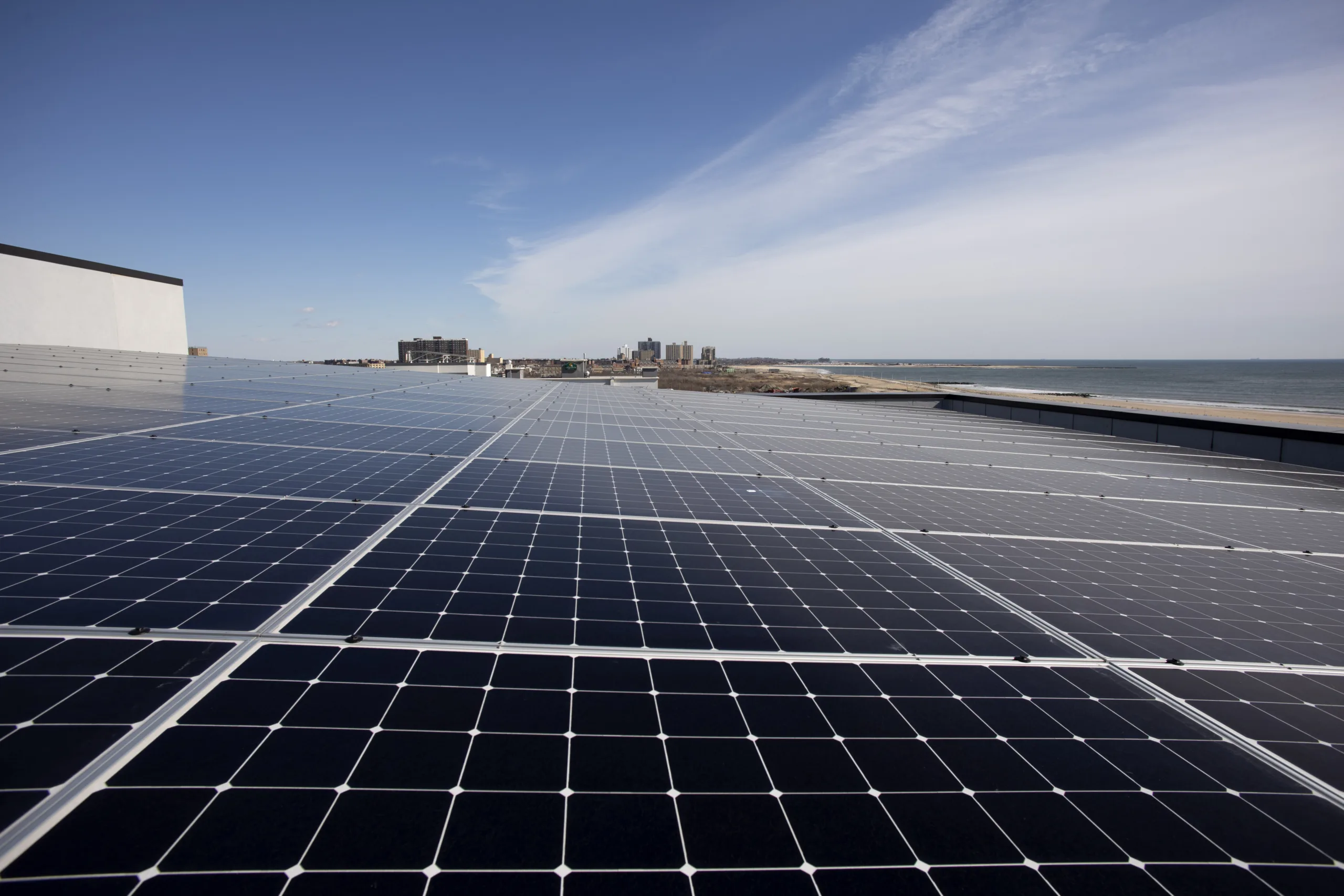
To reach energy affordability, grid resiliency, and climate goals, New York needs a narrow but bold vision: a solar‑battery array on every safe roof.
New York can get there in three ways.
First: Regulatory reform that incentivizes utilities to install this infrastructure.
Utilities are regulated at the state level. Shifting from rate‑based to performance‑based regulation would allow utilities to capitalize “non‑wires solutions” like solar, batteries, and other DER—and recuperate the costs of installing them. Performance‑based regulation aligns utility profits with system‑wide cost reductions, not just with building power plants and substations. In this model, utilities would have a financial incentive to work with property owners to install solar‑battery arrays, strengthening the grid and lowering household bills.
Second: Legislation requiring utilities to provide opt‑out Community Solar subscriptions.
Community Solar lets households without roof access—renters, residents of multifamily buildings, or homes without adequate space—benefit from shared solar and battery infrastructure. Customers pay a subscription fee that supports an offsite solar array and receive bill credits that typically exceed the fee, reducing their monthly costs. Today, this exists only for low‑income ratepayers. Requiring utilities to offer opt‑out Community Solar for all customers—with guaranteed savings—would make DER investment the default, delivering 5–20% bill reductions across the board.
Finally: Require data centers to “bring your own new clean energy.”
Data centers are the disruptive power guzzlers communities fear. If the State moves forward after its pause on large data centers, developers should be required to provide substantial community benefits—including new clean energy for both the project and surrounding neighborhoods. Think of it as BeYONCE: bring your own new clean energy. This would spur DER development at regional scale.
The federal government may have put a knife in the heart of clean energy, but New York doesn’t have to bleed. We can chart our own sunny path to energy affordability.