



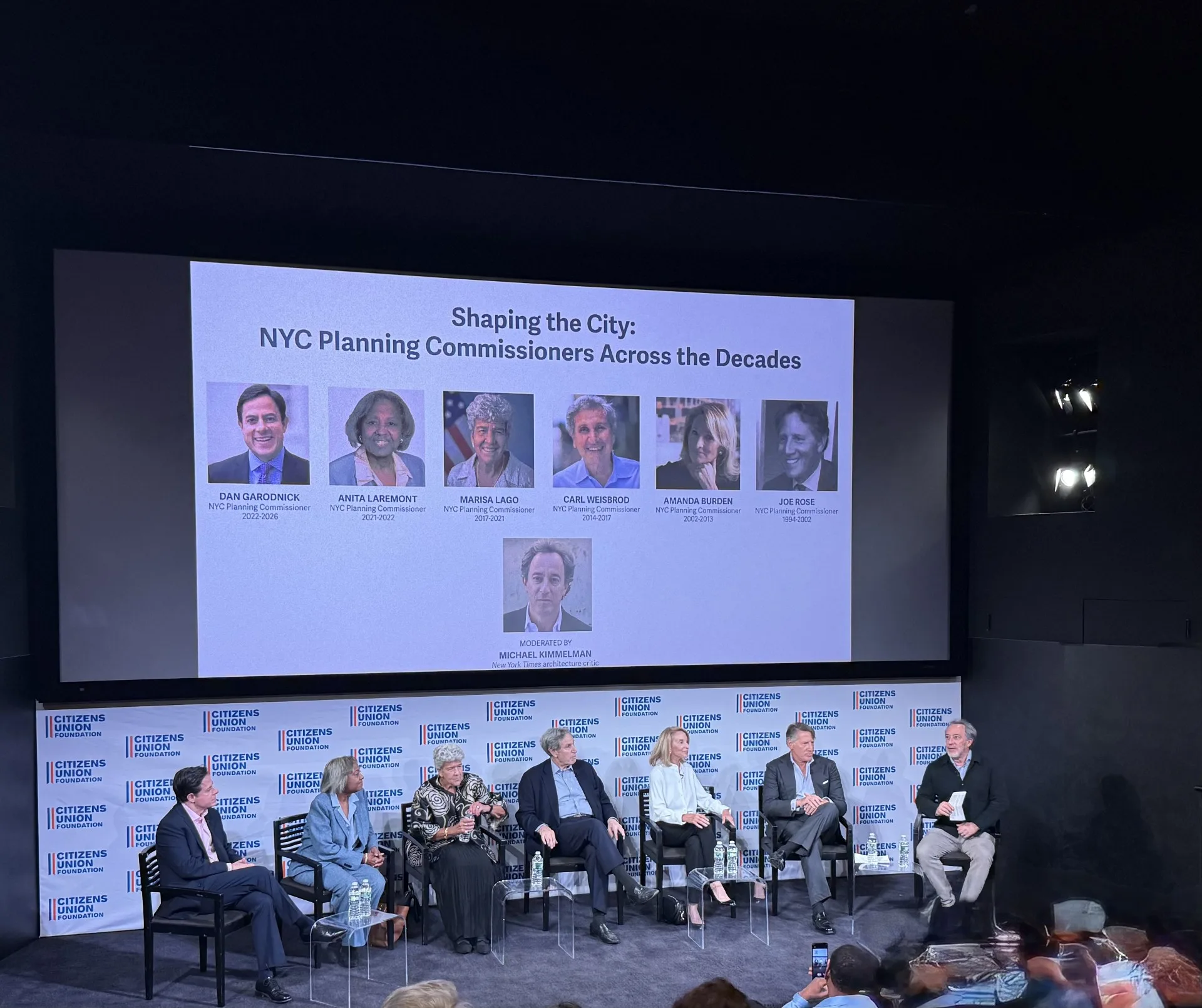
On October 7, the Citizens Union Foundation gathered six former New York City planning commissioners at the Paley Center for Media to consider three decades of development, rezoning and political combat. Representing administrations from Rudy Giuliani through Eric Adams, they agreed on the central diagnosis: New York has failed to build enough housing. On the remedies, consensus quickly broke down.
The discussion came at a particularly consequential moment. Just six days earlier, the city had announced 12 neighborhoods where new charter rules will eliminate the City Council’s final vote on certain affordable housing proposals, shifting more authority to the City Planning Commission. The change is intended to loosen a political bottleneck in a city desperate for housing. It also sharpens a question that ran through the commissioners’ discussion: Who gets to decide what gets built, and how much say should neighborhoods have in the process?
The commissioners approached that question from very different perspectives. They sparred over mandatory affordable-housing requirements, the future of manufacturing districts, the importance of neighborhood character and whether the city’s planning process has become too cumbersome, or is finally becoming capable of delivering the homes New Yorkers need.
The panel featured Joe Rose, who served under Giuliani; Amanda Burden, Michael Bloomberg’s longtime planning chair; Carl Weisbrod, Marisa Lago and Anita Laremont, who served under Bill de Blasio; and Dan Garodnick, who led the department under Adams. New York Times architecture critic Michael Kimmelman moderated.
Their conversation exposed the central tension in New York planning: The city must accommodate people who need homes but have little voice in neighborhood debates, while respecting the communities that already exist. The new charter rules may change who holds the power to resolve that tension. They will not make the underlying choices any easier.
What follows is an edited version of their points and exchanges.
Joe Rose: from “command and control” to growth

Rose described his mandate in the Giuliani administration as straightforward even if it was never formally stated: get New York building housing again.
To do that, he argued, City Planning had to change its institutional posture. The agency needed to move away from what he described as a “command and control approach” and toward policies organized around growth.
Rose cited Columbus Circle, Hudson River Park, the west side waterfront and efforts to protect the Broadway theater district among the major initiatives of his tenure. Early work on the far west side also formed part of the foundation for what ultimately became Hudson Yards.
“It was all under the auspices of a growth-oriented agenda as opposed to what we can stop,” he said.
A related change involved mixed-use zoning. Rose recalled working with Weisbrod on converting Lower Manhattan office buildings to residential use and described his administration’s creation of a mixed-use zoning district as part of a broader attempt to loosen the strict separation of uses that had dominated zoning policy.
That experience shapes Rose’s view of New York’s present housing problem. Over decades, he argued, regulations intended to solve individual problems have accumulated until they begin contradicting one another.
“We sort of have a stack of pancakes of bad regulations that work across purposes to each other,” he said.
Rose was not arguing for the absence of rules. Indeed, he warned that deregulation could overshoot its purpose: “The danger is you go from City of Yes to City of Whatever.”
But throughout the discussion, he consistently occupied the panel’s deregulatory flank. New York’s central problem, in his telling, is not insufficient policy but too many policies layered on top of one another, raising the cost and difficulty of producing housing.
Amanda Burden: growth tied to transit and design

Burden’s starting point was the New York that Bloomberg inherited shortly after September 11.
The city faced what she characterized as a crisis of confidence. Bloomberg responded by investing aggressively in New York’s future and saw land use as one of the principal ways government could act.
“His lead was our lead,” Burden said. “He saw land use as one of the best tools to do that.”
Her department embarked on rezonings across all five boroughs, including Downtown Brooklyn, Downtown Jamaica, the Hub in the Bronx, East and Central Harlem, Williamsburg and other neighborhoods.
Burden emphasized that substantial increases in density were generally concentrated around transit.
“They were geared around transit,” she said.
The principle was both practical and urbanistic. New York needed to accommodate growth without overwhelming its streets and infrastructure, making subway access a logical organizing framework.
On the far west side, Burden’s department developed a Hudson Yards master plan that built on work begun under Rose. In Greenpoint-Williamsburg, rezoning opened roughly two miles of waterfront to new development, including mixed-income housing. By 2007, she said, the City Council had approved 76 rezonings covering some 6,000 blocks.
Burden also highlighted two smaller-scale initiatives that reflected her emphasis on urban life at street level: encouraging sidewalk cafes and helping preserve the High Line, which accompanied the rezoning of West Chelsea.
If there was a major unfinished project of the Bloomberg years, she said, it was East Midtown. The plan came close to approval during Bloomberg’s tenure but ultimately crossed administrations and was approved under de Blasio.
The episode became an early example of another theme the six commissioners shared: consequential planning rarely fits neatly within a mayor’s term.
Carl Weisbrod: affordability and the capital budget

Weisbrod brought a particularly long institutional perspective to the discussion. Before becoming de Blasio’s planning chair, he had served as executive director of City Planning during the Koch administration.
By the beginning of the de Blasio years, he said, the housing problem looked different from the one New York had confronted decades earlier. The city had become increasingly divided economically.
“We had emerging a city of very rich people and very poor people,” he said. “And the poor were not being served effectively by housing.”
Weisbrod’s central initiative was mandatory inclusionary housing, or MIH, which requires a share of permanently affordable housing when additional residential development rights are granted in designated rezoned neighborhoods.
East New York became an early test.
A decade later, Weisbrod said, the neighborhood had added 6,000 units, 3,700 of them affordable, without the level of displacement and gentrification critics had feared. He attributed that outcome in significant part to MIH.
For Weisbrod, however, affordable housing requirements were not simply about achieving a numerical target. They reflected an underlying preference for economically integrated buildings and neighborhoods, an issue that later produced one of the evening’s sharpest exchanges with Rose.
The capital budget link
Weisbrod’s second major priority went beyond zoning.
Rezonings routinely come with promises for schools, parks, transportation improvements and other public infrastructure. Historically, he said, communities had ample reason to doubt whether those promises would materialize.
Working with the Office of Management and Budget, his administration established a Neighborhood Development Fund designed to put money behind those commitments.
“There’s a long history of promises being made and not being kept,” he said. “And we wanted to make sure that money was in the budget.”
That led Weisbrod to a larger institutional point. Before 1975, he noted, City Planning and OMB jointly created and managed the city’s capital budget. Removing Planning from that role separated decisions about land use from decisions about the public investments necessary to support it.
“I think that we lost that ability to be as broadly thoughtful about where our capital dollars are spent as we should be,” he said.
The implication was that zoning alone cannot constitute planning. If New York intends to add residents to a neighborhood, government also has to plan and pay for the infrastructure that makes additional growth sustainable.
Marisa Lago: planning across generations

Lago succeeded Weisbrod as New York was booming, its population was growing and, in her description, NIMBYism was approaching a peak.
She emphasized the long time horizon of city planning.
“There is a through line that a planning idea that may have originated as far back as Joe comes to fruition decades later,” Lago said.
She pointed to Jerome Avenue in the Bronx, where planning sought to accommodate housing and jobs along the elevated 4 train; Gowanus, where the challenge included planning around a Superfund cleanup that itself would take years; and the Brooklyn Navy Yard, where land-use decisions could shape development for generations.
Good planning, in that formulation, cannot be judged solely by what gets built during the tenure of the commissioner who initiates it.
Zoning for accessibility
Lago singled out zoning for subway accessibility as an example of using private development to advance a broader public goal.
Existing rules offered additional development capacity in some dense areas when a developer helped make a nearby subway station accessible. The geographical limit on that incentive, however, was narrow.
“We realized that New Yorkers will gladly walk more than 100 feet to a subway station,” Lago said.
Her department expanded the area within which the incentive could apply. She credited collaboration with transportation and MTA officials for helping extend the reach of station accessibility improvements.
The policy reflected a recurring theme in Lago’s comments: zoning works best when it is coordinated with the agencies responsible for the systems around it.
Planning through COVID
COVID made that interdependence impossible to ignore.
When the pandemic struck, City Planning’s analytical ability was redirected toward emergency needs. Planners helped government analyze where food assistance was required, where subway stations needed staffing and where hospitals needed additional personnel.
“At that point, it wasn’t about building new buildings, but how we could plan for what was the most important issue of the day,” Lago said.
The episode broadened the definition of planning itself. The department’s value was not limited to determining where and how New York should build. Its understanding of neighborhoods, population and infrastructure could also be applied to an immediate public emergency.
Anita Laremont: equity, SoHo and local power

Laremont, who led the department late in the de Blasio administration, likewise described COVID as a moment that forced planners to reconsider what makes a neighborhood function.
The department became interested in the concept of the 15-minute neighborhood, in which work, recreation and ordinary daily needs are accessible close to home. More urgently, the pandemic revealed sharp disparities in access to health care and information.
“What we learned very early on in COVID was the very, very significant differences in access to health care,” she said.
Those inequalities were reflected in dramatically different outcomes among neighborhoods. City Planning worked with the Health Department on the issue, and Laremont said the experience produced lasting changes in how the department considers equitable access.
But the pandemic did not alter one fact of planning: translating a new understanding of a problem into the physical city takes years.
SoHo as a symbol
For Laremont, the SoHo rezoning late in the de Blasio administration was important both practically and politically.
The administration had been criticized for directing rezonings toward lower-income communities while asking relatively little of wealthy neighborhoods. SoHo offered a prominent response to that charge.
The rezoning was hard-fought, and its effects have taken time to become visible.
“Most rezonings take maybe 10 years to get anywhere close to the number of units that were projected,” Laremont said.
Greater East Midtown was an exception because projects were ready to move quickly once the zoning changed. SoHo faced different circumstances, including litigation and complications involving former artist spaces.
The lesson, she suggested, is that the consequences of land-use decisions cannot be assessed on an election-cycle timetable. A rezoning changes what can happen; the market, property owners, litigation and other forces determine how quickly that potential becomes physical development.
Dan Garodnick: City of Yes and the case for supply

Garodnick entered City Planning in 2022 at the tail end of COVID, with two related goals: increase housing production and help New York recover.
His argument for more housing was emphatically historical rather than speculative.
The city’s most recent Housing and Vacancy Survey, he noted, found the lowest vacancy rate since 1968. High rents, weak tenant bargaining power, displacement and gentrification pressures followed from the same underlying scarcity.
“You look backwards and you look forward,” Garodnick said.
Looking backward showed decades in which New York had failed to create enough housing to meet demand. Looking forward, he argued, offered no reason to conclude that the city should pull back.
City of Yes
Garodnick’s signature initiative was City of Yes, a sweeping reconsideration of zoning undertaken through three packages addressing environmental policy, economic development and housing.
The premise was partly that the city had changed faster than its rules.
Post-pandemic work patterns offered a simple illustration. More people spending days in residential neighborhoods could increase demand for businesses such as local bakeries, yet older home-occupation rules could prevent businesses from responding.
“We took a fresh look at all of that and we did a complete overhaul citywide, three times,” Garodnick said.
On housing, he characterized City of Yes as intentionally modest at the scale of an individual neighborhood: allowing three- to five-story buildings in appropriate lower-density locations near transit and commercial corridors, while providing some additional capacity for affordable housing in medium- and higher-density districts.
“It was neighborhood specific by definition,” he said, “and it was designed to be respectful of the community.”
That characterization went to the heart of the evening’s broader dispute: whether citywide rules can simultaneously produce enough housing and remain responsive to the physical character of distinct neighborhoods.
Housing and the shadow of Robert Moses
One of the discussion’s central questions was whether today’s conviction that New York must build substantially more housing risks replacing one kind of planning orthodoxy with another.
Garodnick argued that the housing shortage was not simply a projection of future demand. It was a condition documented by decades of experience and reflected in the vacancy rate.
Laremont shifted the focus to political process. In her view, the challenge is whether city government can consider citywide needs without every proposal becoming captive to hyperlocal opposition. Council deference to the member representing the affected district has often given neighborhood politics enormous influence over questions with implications for the whole city.
Lago added another constituency: people who are not yet in the room. Future New Yorkers, including immigrants and people moving from elsewhere, cannot appear at a community meeting to advocate for the housing they may someday need.
“That is the responsibility and the beauty of city planning that you do think over decades, not just the decision in front of you,” she said.
Weisbrod described planning as necessarily both responsive and directive. Government reacts to market forces, but at its best it also anticipates and shapes them.
Rose distilled the disagreement. The commissioners could agree that City Planning has an essential role in facilitating housing construction, he said, while disagreeing “profoundly about the mechanisms.”
Mandatory inclusionary housing
Those mechanisms came most sharply into conflict over MIH.
Rose questioned whether requiring affordable units as part of rezonings ultimately inhibits housing production. Because MIH does not require the same direct capital expenditure as publicly subsidized housing, he argued, it offers government an attractive means of producing affordability while imposing additional costs on private development.
His alternative was not to abandon affordable housing subsidy but to rely more heavily on increasing development capacity and removing regulations that prevent construction.
Garodnick strongly disagreed. If the city grants a developer additional value through increased zoning capacity, he argued, it is reasonable to secure affordable housing in return.
“It has delivered a lot of affordable housing,” he said.
Weisbrod widened the argument beyond unit counts.
“The key to MIH is not just that you’re producing a certain amount of affordable housing,” he said, but that it creates mixed-income housing and mixed-income neighborhoods.
He argued that mixed-income buildings are better positioned for long-term maintenance and reinvestment, with market-rate operations helping support affordable units.
Rose agreed on the desirability of mixed-income neighborhoods but drew the line at individual buildings.
“I agree about the neighborhood, absolutely,” he said. “I’ve never seen any data that points to the need for a mixed-income building” sufficient to justify what he viewed as its economic and regulatory cost.
Lago offered an urban-design observation. New Yorkers can frequently identify the program responsible for a building simply from its physical form: NYCHA, Mitchell-Lama or other categories of subsidized development. Mixed-income buildings can instead become visually indistinguishable from the surrounding neighborhood.
Burden reframed the entire exchange. The question should not simply be which mechanism produces the most units, she suggested. Preservation of existing affordable housing matters too, as does what development does to the surrounding place.
“Do they strengthen neighborhoods or not?” she asked.
What to do with manufacturing land
The same tension between citywide necessity and redevelopment emerged in the discussion of manufacturing districts.
Burden argued strongly for protecting what she called “deep purple” industrial land. These areas accommodate sewage and sanitation infrastructure, waste transfer, recycling and other uses that may be incompatible with housing but are essential to New York’s operation.
“You have to keep deep purple because that’s what makes the city run,” she said.
Garodnick agreed about essential industrial functions while arguing that the city should reconsider some industrial business zones. An IBZ designation does not necessarily mean that every property inside it requires permanent industrial protection.
Certain areas could accommodate a mix of manufacturing and residential activity, he said, pointing to manufacturing-only pockets in Midtown South where restrictions had been relaxed.
Rose traced the issue to the city’s 1972 industrial policy, which attempted to protect manufacturing by limiting competing residential and retail uses. That framework applied even in some areas where people already lived.
He regarded the underlying policy as a serious historical error and another example of an old regulatory solution outliving the circumstances that produced it.
Lago again emphasized coordination across agencies. Some “deep purple” land is publicly owned and necessary for sanitation, transportation and other essential operations. But examining those holdings systematically can reveal places where public functions can operate more efficiently while freeing adjacent land for other purposes.
The debate was therefore less about choosing housing over industry than determining which industrial functions genuinely require protection and where inherited zoning has become detached from contemporary conditions.
Urban design, neighborhood character and community consent
Burden made the strongest case for restoring neighborhood quality to the center of the housing discussion.
“Every neighborhood in New York City is different,” she said.
Planners therefore have to understand a neighborhood before deciding how much growth it can absorb and what that growth should look like. Transit provides capacity, but it does not by itself dictate urban form.
Burden also described design as a way to make an otherwise impenetrable planning process accessible. Zoning categories such as R7-3 or C6-1 communicate little to most residents. Drawings allow people to see what the rules could produce.
During the Greenpoint-Williamsburg planning process, her department’s urban designers translated proposed zoning into physical images residents could understand and critique.
“We used this team of urban designers to build consensus,” Burden said.
Rose agreed that design matters but resisted the implication that every neighborhood requires its own highly tailored regulatory scheme. He favored simple, broadly applicable principles. A wide street that already accommodates six-story buildings on one side, he argued, ought generally to permit comparable development on the other.
Burden countered that even this depends on location. In some places, wider streets and transit might justify considerably more height.
Laremont noted that modest density does not necessarily eliminate neighborhood opposition. Proposals for four- to six-story development near transit in Staten Island town centers still encountered resistance.
Rose’s reply neatly captured the distinction between technically workable policy and political consent: he had said it would work, not that everybody would like it.
Laremont and Garodnick emphasized that design remains embedded in the department’s work even as its organizational structure has changed. Garodnick stressed the importance of visual communication precisely because zoning language itself alienates non-specialists.
Lago recalled a Bay Street meeting on Staten Island at which planners translated residents’ concerns into sketches in real time. Once people could see what a proposal might actually look like rather than confronting abstract zoning terminology, she said, “the temperature goes down.”
She also described a change in framing. The discussion need not begin with what a developer wants to construct. It could begin with whether children raised in the neighborhood will be able to find homes there as adults.
That distinction goes to the difficult politics of development. The same apartment building can be understood either as an intrusion imposed on an existing neighborhood or as a home for someone the neighborhood does not yet accommodate.
A new balance of planning power
The new charter rules brought many of the evening’s arguments together.
Weisbrod saw the reforms as another swing of the political pendulum. After a period in which land-use decisions increasingly emphasized local process and political review, power was shifting toward government’s capacity to make decisions at the citywide level.
That makes City Planning, the Planning Commission and OMB more consequential. Choices that once might have been resolved through negotiations with a council member could increasingly have to be settled within the planning process itself.
That, Weisbrod argued, increases rather than diminishes the responsibility of planners to consider affordability, public investment, design and neighborhood impacts.
Burden was more skeptical, particularly about what the change means for community participation.
Garodnick made a narrower distinction. Ending the process at the Planning Commission does not mean eliminating public participation. It does, however, alter the political structure surrounding it.
Previously, commissioners operated knowing that their decisions would be followed by a Council process. Without that backstop in the affected cases, questions arise about whether commissioners themselves will become more directly exposed to political pressure and how their representative roles will evolve.
“This changes that completely for those 12 neighborhoods,” Garodnick said.
Lago, meanwhile, emphasized that formal votes reveal only a portion of City Planning’s influence. Borough planners know their districts, and questionable proposals may be reshaped or abandoned well before a commission vote.
She also questioned the deceptively simple idea of “the community.” Is the community represented by long-established property owners, residents who arrived a few years ago and want the neighborhood frozen as they found it, or people who do not yet live there but need somewhere to live?
There was no single answer. But the question captured the dilemma of planning in a housing-starved city: those who stand to benefit from future development frequently have less political standing than those who already occupy the places where development could occur.
Planning beyond the political cycle
Across their differences, the six commissioners described an institution whose work routinely outlasts the administrations directing it.
East Midtown moved from Bloomberg to de Blasio. East New York also originated in work begun under Bloomberg before becoming a centerpiece of de Blasio’s housing agenda. Hudson Yards reflected planning that reached across mayoralties. Gowanus and the Brooklyn Navy Yard were conceived on timelines extending well beyond the officials who approved them.
That continuity explains why the commissioners repeatedly returned to the professional staff of City Planning.
Political leadership determines priorities, but planners preserve institutional knowledge, refine proposals and carry projects through transitions that can otherwise disrupt long-term policy.
“This continuum is extremely, extremely important,” Burden said.
The commissioners also shared a conviction that housing cannot be separated entirely from the other elements of city building. Even the evening’s strongest advocate for regulatory simplification did not argue that planning should disappear. The disagreement concerned what planning ought to demand and how prescriptive it should become.
Rose’s emphasis was production: rules should facilitate growth rather than accumulate until they prevent it.
Burden insisted that the quality and distinctiveness of neighborhoods remain central, with transit and urban design shaping where and how density is added.
Weisbrod argued that development rights should advance affordability and that rezoning must be connected to public capital investment.
Lago stressed planning’s long horizon and its responsibility to future residents as well as current ones.
Laremont focused on equity and on a political structure that can allow intensely local interests to override broader needs.
Garodnick made the case that decades of scarcity justify citywide action and that outdated zoning itself can become an obstacle to affordability and recovery.
Their sharpest disagreement was therefore not over whether New York should grow. It was over the bargain the city should strike as it grows.
Should the primary objective be to make construction easier and allow supply to respond? Should new development capacity carry obligations for permanent affordability? How much variation should zoning allow between neighborhoods? How much authority should existing residents have over housing for people who may arrive years from now? And when political veto points are removed, what must planners do to retain public trust?
Three decades of experience offered no settled formula.
Instead, the commissioners described planning as an inherently cumulative enterprise. One generation of rules addresses the failures of another. A rezoning begun under one mayor becomes the achievement of the next. Policies designed to protect neighborhoods can eventually constrain them; rules intended to foster growth can create consequences that require subsequent correction.
That may be the strongest argument for the institutional continuity the commissioners repeatedly praised. New York changes too quickly for any administration to plan it definitively, but too slowly for consequential planning to fit within a single administration.
The housing shortage gives the current debate unusual urgency. Yet the conversation among six commissioners suggested that the enduring task is larger than producing a particular number of units. It is to make room for a changing city while preserving the infrastructure, economic diversity, public realm and neighborhood qualities that allow that city to function.
On the need to make room, the commissioners were strikingly close. On how to do it, three decades of planning left plenty to debate.